How Jim Akins shaped musicians far beyond the notes
The beloved tuba professor and two-time alum urged students to imagine boldly, play lyrically and trust their own ideas.
Recordings of Jim Akins ’78, ’82 MA showcase his mastery of the tuba. In them, you can hear the booming power he provides an orchestra, but his virtuosity and imagination also add artistic elegance, as if he were singing.
“His sound was amazing,” Lori Akins ’78, ’82 MA says of her husband of 47 years. “It was the loveliest sound you could ever imagine coming out of a tuba. You didn’t know it was possible because it was so lyrical, warm and sonorous. He had that gift.”
Just as low, big brass notes resonate, rich memories of Akins also reverberate in the sound of tubas played by countless Ohio State students. He taught them to find expressions of their own musical gifts during his 30-plus years as associate professor of tuba and euphonium studio in the School of Music.
“He certainly taught the notes and the technique, but he was more interested in creating musicians,” says Julianne Akins Smith ’09, who learned tuba from her father. “He invited you to discover what the music means to you.”
Akins, widely considered a world-class player during his 40 years as principal tuba with the Columbus Symphony Orchestra, offered those opportunities for self-discovery of creativity up into the month of his death on Dec. 29, 2025, after a sudden and brief illness.
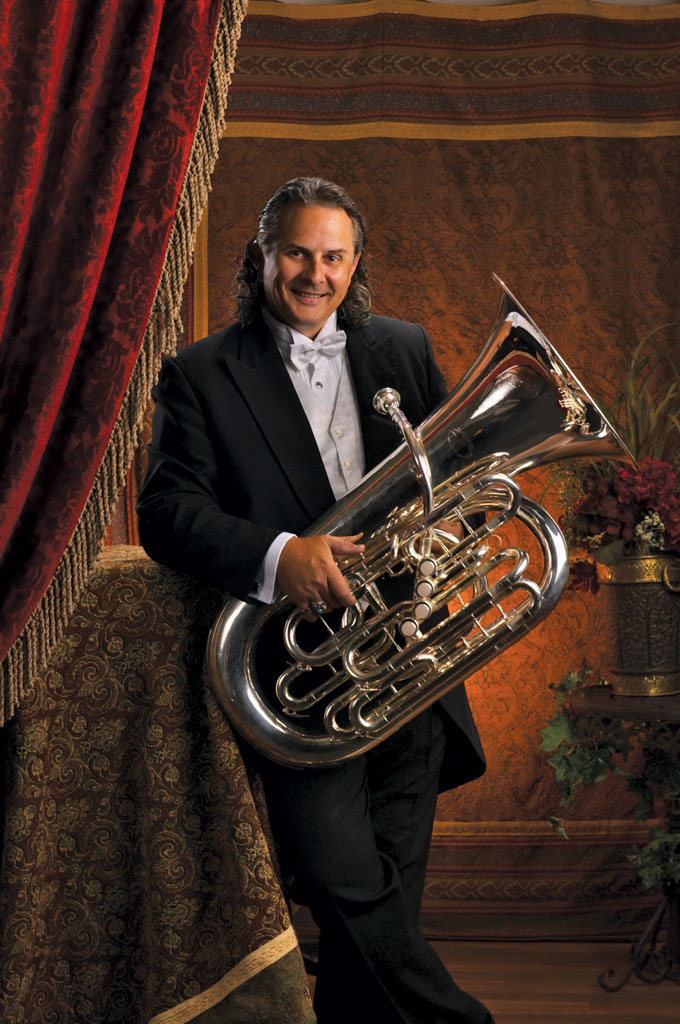
“Jim cared so, so much about you,” says Justin White ’22 MM, a doctoral teaching assistant under Akins. “He supported his students in every way, shape and form. Even with everything going on in his life, he still made time for everybody else.”
Akins’ generosity never wavered in 15 years of chronic health issues caused by vibratory angioedema. He stoically battled that rare condition—sound vibrations caused him painful hives, body swelling and debilitating headaches—despite it leaving him unable to play tuba most of his life’s final decade. He still could play Native American-style flute and listen to all music, and he powered on as a professor, teaching a full course load the entire semester last fall.
“Jim fought through everything,” says Lori, an associate musician with the Columbus Symphony Orchestra and flute instructor at Cedarville University. “His eyes were so bad [from cortisone treatments] that he couldn’t drive at night, but he was determined to keep teaching. He was still connecting with students.
“He enjoyed the fact that he could help them find the best in themselves, find out who they were. He was good at helping them tap into being confident with their own ideas, showing them that you don’t have to stay within all the guidelines, don’t have to just go by the notes. You can find other ways to do things. Your voice matters.”
White’s understanding of this began when he first played in class as an Ohio State graduate student. Akins heard his clean, unemotional notes and demanded more than rote rendition by asking: “What’s your story with this?”
To prompt a creative approach for a second playing, Akins showed his perplexed pupil a photo of a man inside New York’s Grand Central Terminal. “What is this guy doing?” Akins asked White. “What time of year is this? What’s the weather outside? How can you build this story into the music that you’re playing? How can you convey this to your audience?”
Sometimes after a student played a score, Akins responded by pulling out two crayon boxes and saying: “Right now, you’re using the box of four colors. That’s boring. What can you really do with that? Use that box of 360 colors because then your options are unlimited. You can do so much more than what’s on the page.”
Akins took knowledge learned as an Ohio State student from Professor Robert LeBlanc, refined it with his renaissance approach and passed it on in unique ways. “He was willing to adapt for the student,” White says.
His studio also was a portal into a kaleidoscope of interests and hobbies. A bow and arrow, fountain pens, electrical gadgets and other objects filled the room, where old stereo speakers often blared his favorite composer, Gustav Mahler. All students were welcomed as their own selves to hang out, voice opinions, push boundaries and meet high standards, as Akins always demanded of himself, too.
They grew as musicians and people, and their mentor also benefited. “He would always come home and tell me stories about the students,” Lori says.

She began dating Jim when they were Ohio State undergraduates, soon after meeting while standing atop a metro bus on High Street after a Buckeyes’ football win. “It was a thing in the ’70s,” says a grinning Lori, wearing the blue Linde Star sapphire necklace that he gave her in college.
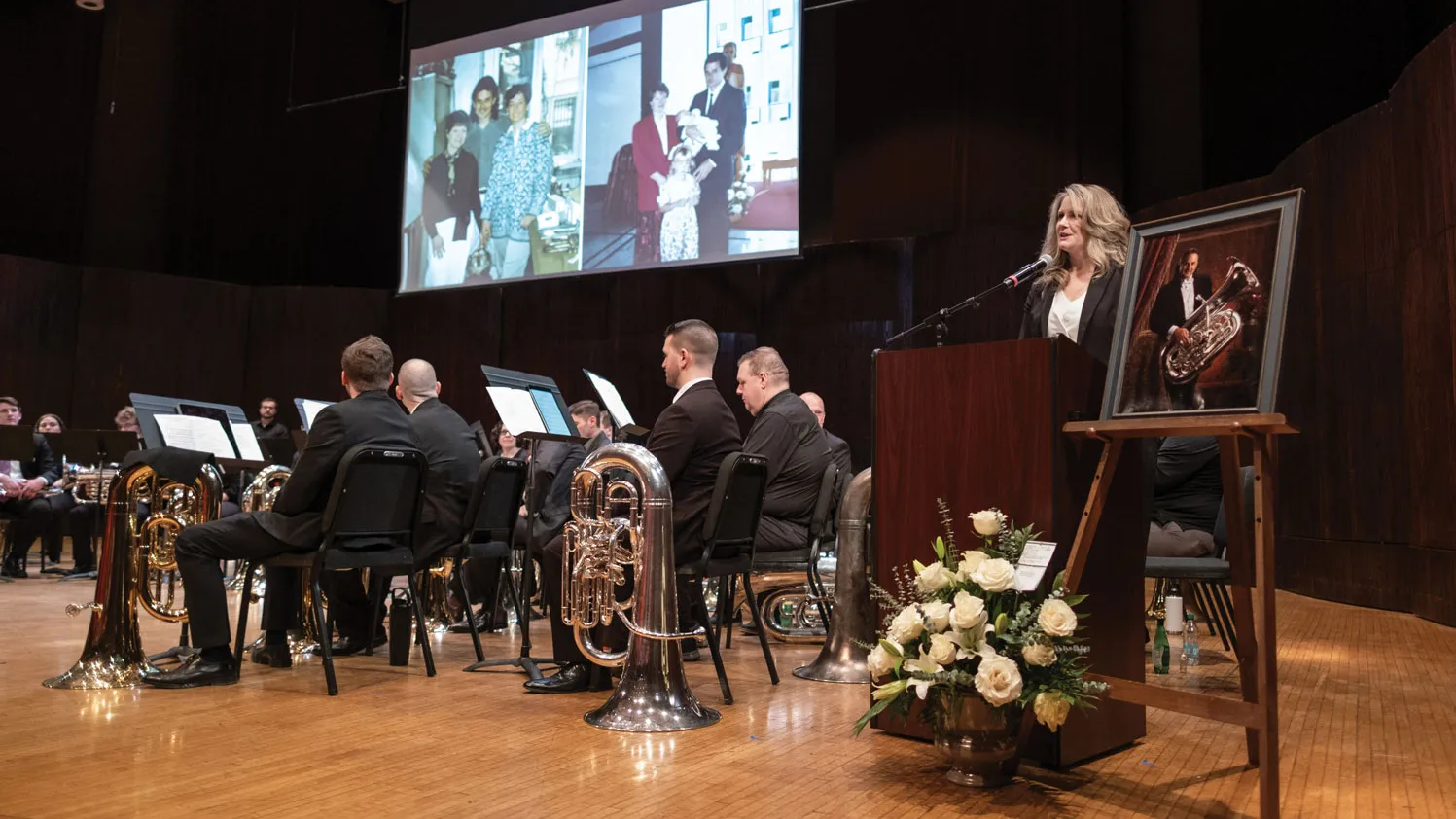
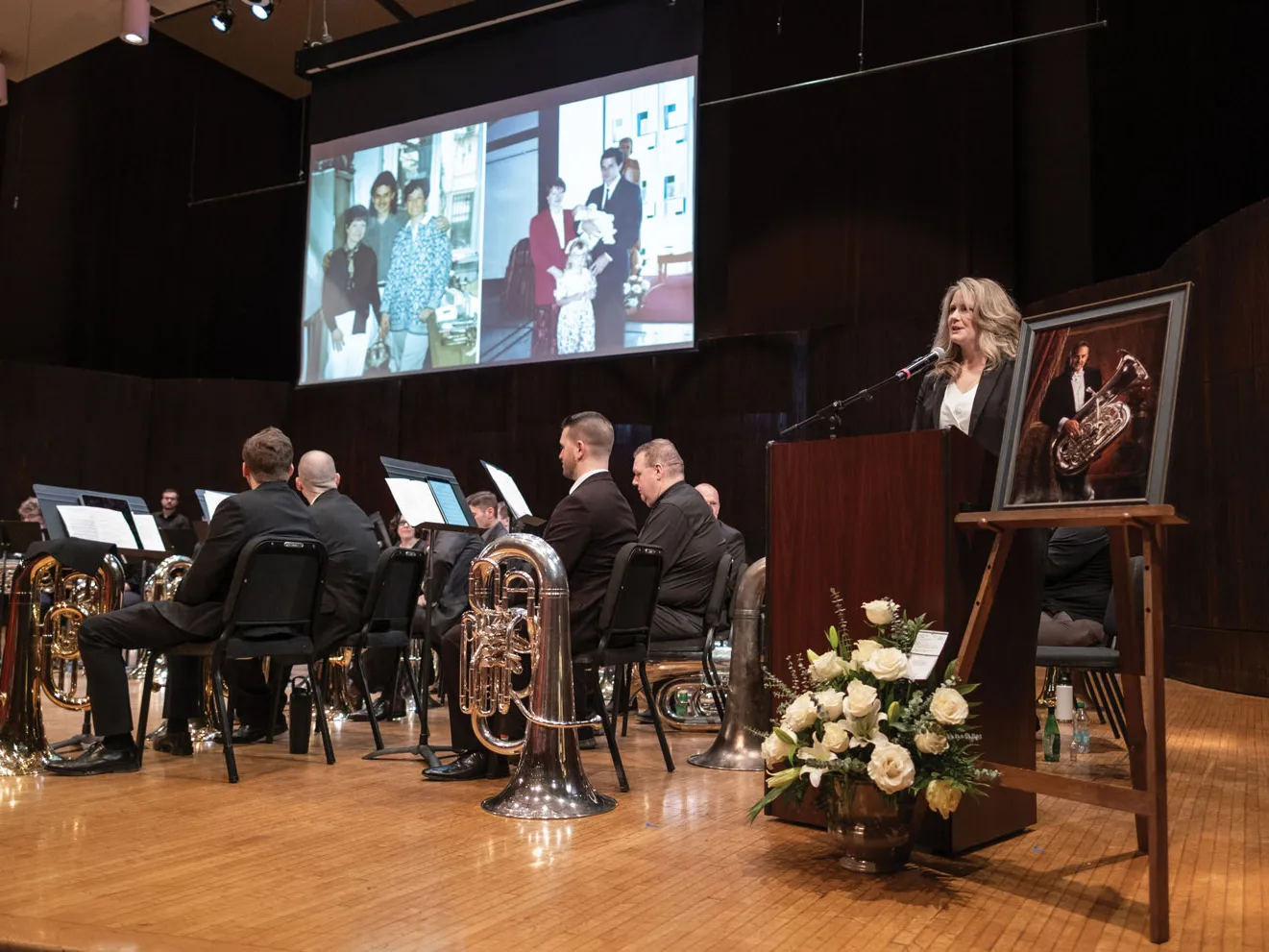
Lori, Julianne, daughter Amanda Christine Akins ’13, ’15 MEd, other family and a couple hundred of Jim’s friends, colleagues and past and present students gathered at Weigel Hall in March for a musical celebration of his life held by the School of Music. Stories were shared about Akins’ exquisite tuba playing, how he handcrafted and played Native American-style flutes, could fix anything, was loyal to others, endlessly curious, a fighter and force of nature.
And stories could be heard when 40-plus musicians, including White and Julianne, played renditions of music that he loved, in their own passionate way, just as he encouraged.
“His musical approach to life lives on, especially through his students,” Julianne says.