True story! These Buckeyes met Hemingway in Cuba
After a spring break jailing and help from Woody Hayes, this football champ and friends traded stories with the iconic author.
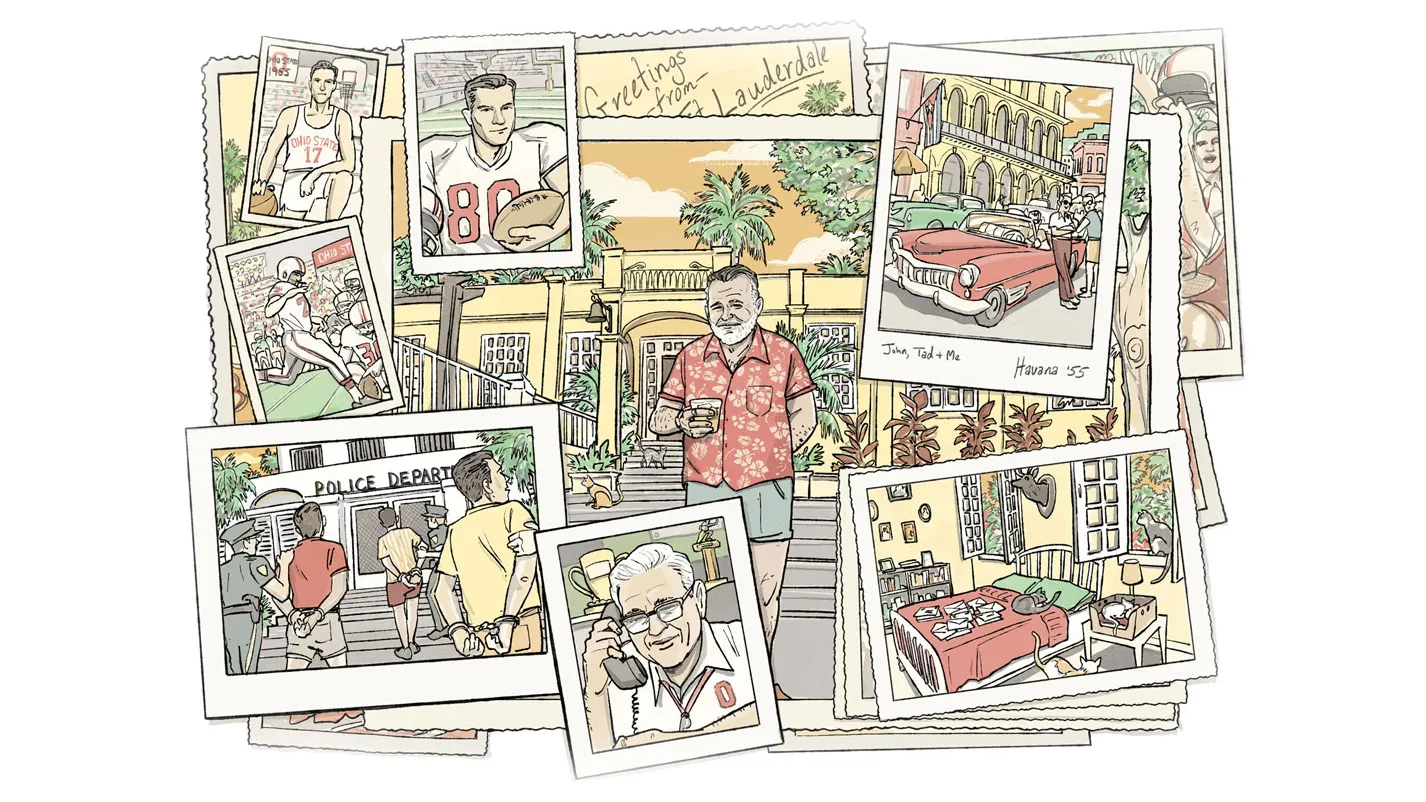
He stood there in shorts and a Hawaiian shirt, bigger than life, welcoming us with a warm, mischievous smile. Ernest Hemingway seemed genuinely happy to see us.
It was 1955, and our Ohio State football team had been crowned the national champion, led by coach Woody Hayes. I was a team co-captain. After a long and grueling season, I had headed to Florida for a well-deserved spring break with a couple of friends—my teammate and our place kicker, Tad Weed ’56, and the captain of the Ohio State basketball team, John Miller ’55.
It all started when we were lying on the beach in Fort Lauderdale, soaking up the rays. Out of the blue, Tad said, “Let’s go to Cuba.”
Cuba? I thought, is he serious? I had never been to a foreign country, other than Canada, let alone one reportedly ruled by a dictator and where it seemed to be well known that corruption and the suppression of human rights were the norm.
I was about to voice my concerns when John said, “Great idea!”
He was a Hemingway fan and knew the writer lived “somewhere near Havana.” He suggested we could “look him up.” Wishful thinking, I assumed. But their enthusiasm convinced me, and (with the words of my apoplectic parents ringing in my ears) we booked a flight from Key West to Havana for the next day, something you could do in those pre-Castro days.
Our trip turned into a nightmare before we left Florida. Police cars with flashing red lights waited at the airport. We were wondering what had happened and soon found out it directly involved us. Police officers surrounded our cab, hauled us out and patted us down, handcuffed us and dragged us off to jail.
Thinking it was one big joke and being the wise guy that I am, I remember blurting, “Tad, did you hide the diamonds in your shoes?” That question may not have helped our cause.
We spent the next three hours being grilled by accusatory, mean and aggressive detectives in separate claustrophobic cells. There was nothing to sit on except a dirty seatless toilet or a foul, stained mattress. I chose to stand.
It seemed to take forever to learn why we had been arrested. The accusation? Suspicion of murder! A woman had been knifed to death the night of our arrival, and at breakfast the next morning, our waitress apparently noticed Tad’s switchblade knife and our rush to catch a flight. She called the police.
I’m not sure what would have happened if we had been arrested in Cuba, but in the United States, we knew the right to due process applied, so we got to make a phone call. That call went to the most influential person we knew: Woody. With his melodious voice and tremendous powers of persuasion, he assured the detectives we were not guilty—and even persuaded them to drive us back to the airport!
We took the next flight to Havana, hoping our adventure would turn less dangerous.
The cheapo hotel rooms we got were not much different from our Key West jail cells, only larger and cleaner. There was no glass in the windows, just open spaces to the outside, and the mattresses were lumpy and filled with straw. But as poor college students, that was all we could afford.
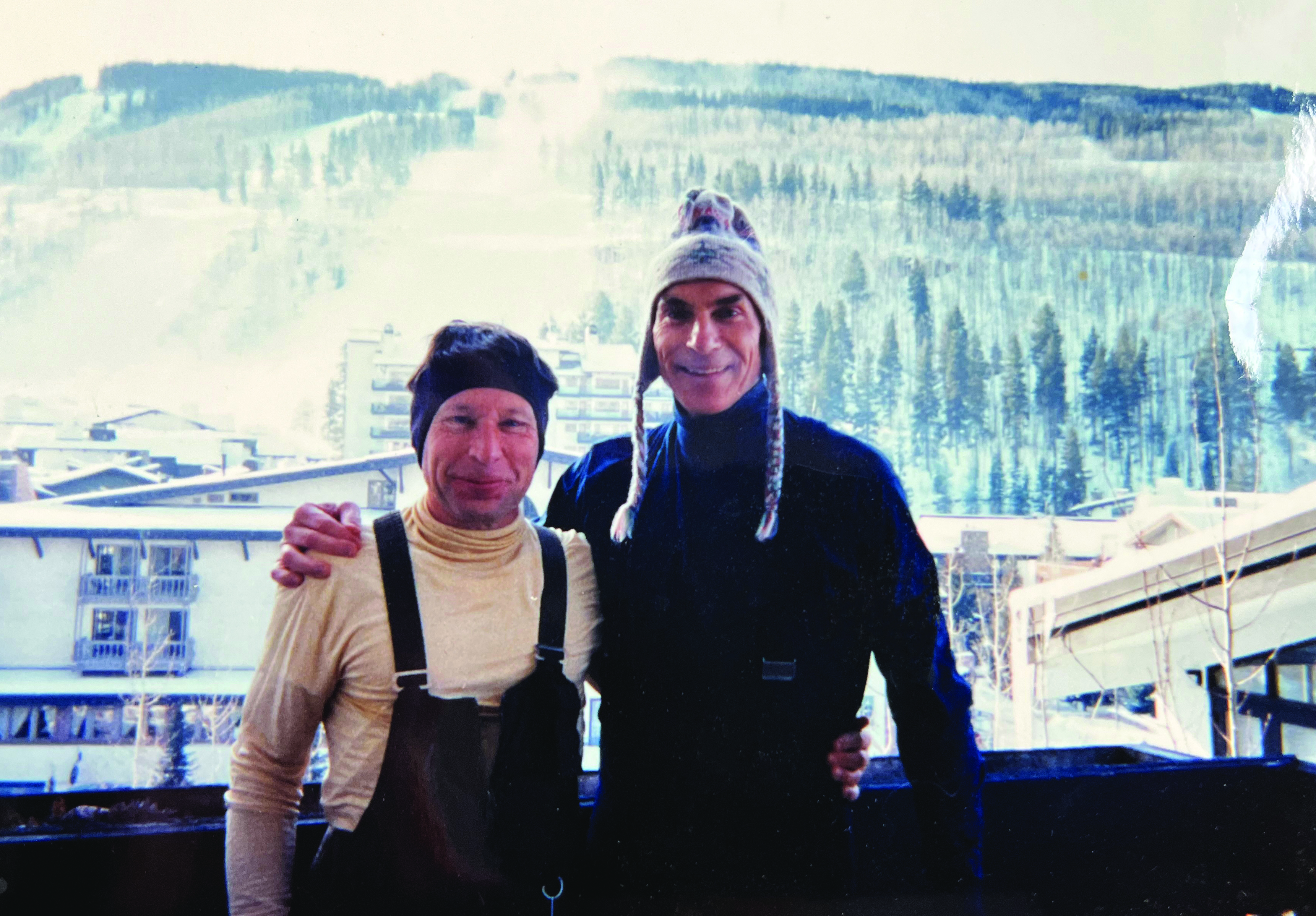
It was a hot, humid evening, but we wasted no time finding Hemingway’s estate, Finca Vigía, in San Francisco de Paula. It was easier than I imagined. As we stood before the wrought iron gate, Hemingway’s personal secretary, a well-dressed gentleman named Roberto Huerra Sotolongo, appeared. We explained that we would like to meet the great author. With a doubtful expression, Sotolongo gave us a phone number and said to call the following day.
Disheartened, we found our way to the nearby cafe suggested by Sotolongo. Just as we were ordering dinner, he rushed in and declared, “Hemingway wants to meet you now!” Hemingway apparently loved visitors.
The memory is still so clear: the long, winding driveway through tropical foliage. The massive stone steps leading up to the entrance of the house. And Hemingway there to greet us, a drink in hand.
Hemingway could not have been more gracious and welcoming. He offered us drinks, and we talked for at least two and a half hours. We inquired about the inspiration for his ideas. He explained he focused on the tension between success and failure, bravery, fear of death and especially not living fully by wasting one’s talents.
Hemingway was curious about us, too, what we were studying and our experiences as athletes in big-time sports programs. He apologetically admitted that he had never heard of us, which was refreshing and required no apology.
For him, the recent years had been eventful. In 1953, he won the Pulitzer Prize for The Old Man and the Sea. In 1954, he survived two airplane crashes in Africa, the resulting scars still visible on his forehead, and won the Nobel Prize in Literature. However, Hemingway seemed unaffected by those honors. Congratulatory letters and telegrams, many unopened, were scattered about in random fashion on a bed.
The actors Gary Cooper and Ingrid Bergman, who had starred in the film adaptation of Hemingway’s For Whom the Bell Tolls, had apparently just visited and Hemingway expressed how pleased he was by their performances.
Although Hemingway was a big game hunter, he loved cats. Beside his bed was a cardboard box for his cat and newly born kittens. He told us that he wanted to be near them, to offer help during the night, if necessary, an endearing feature of his humanity.
Hemingway led us to his veranda. It was peaceful and beautiful. In the distance were the blinking lights of Havana, a breathtaking view that he said he loved the best.
Over the years, I have wondered why Hemingway took an interest in us and shared such personal information. But perhaps he saw that we had no hidden agenda and wanted nothing from him, other than to talk. We had no camera, for which I am grateful, but sometimes sorry. We didn’t ask for his autograph because it never occurred to us.
He displayed powerful charisma and self-confidence, unsurprising considering his success and bigger-than-life existence. Nevertheless, he seemed such a decent human being, who, although associated with the rich and famous, was comfortable with those who were neither. He probably never gave us another thought but I hope that, for one evening, he found some enjoyment with us.
When we got back to Columbus, we shared our story with Woody. He was fascinated and, in turn, often shared the story in his recruiting efforts. Our Key West incarceration lived on, as Woody jokingly boasted about his involvement in the Florida criminal justice system.
I found my apprehension about venturing to Cuba had been misguided. We experienced no discomfort or unusual treatment. Those we met seemed no different from us—just people who wanted to be treated kindly, respectfully and fairly.
Unfortunately, my three great friends and life influencers, John, Tad and Woody, have died, so only my memory carries on. But it is a memory that will bind us together forever.
X
About the author
Richard “Dick” Brubaker ’55 kept notes during his trip and has retold this great story many times over the years, which keeps the details fresh. After Ohio State, he went on to play pro football—two seasons for the Chicago Cardinals, interrupted when he was drafted by the U.S. Navy. His last season was as a founding member of the Buffalo Bills. He also got a law degree, went into estates and trusts, and made his home in Newbury, Ohio, where he still lives today (with his wife, Karen, and their dog, Dini) in between adventures.
Have a Buckeye story you want to share?
Ohio State Alumni Magazine loves hearing quintessentially Ohio State tales of daring and adventure—you don’t have to be a football champion to make us interested. (But Woody Hayes making a cameo appearance never hurts!) Send your stories to our inbox at AlumniMagazine@osu.edu.