A healthy pet playbook from a Buckeye veterinarian
Kristen Miles ’11 DVM shares practical advice on weight, nutrition, calming anxious cats and tick protection year-round.
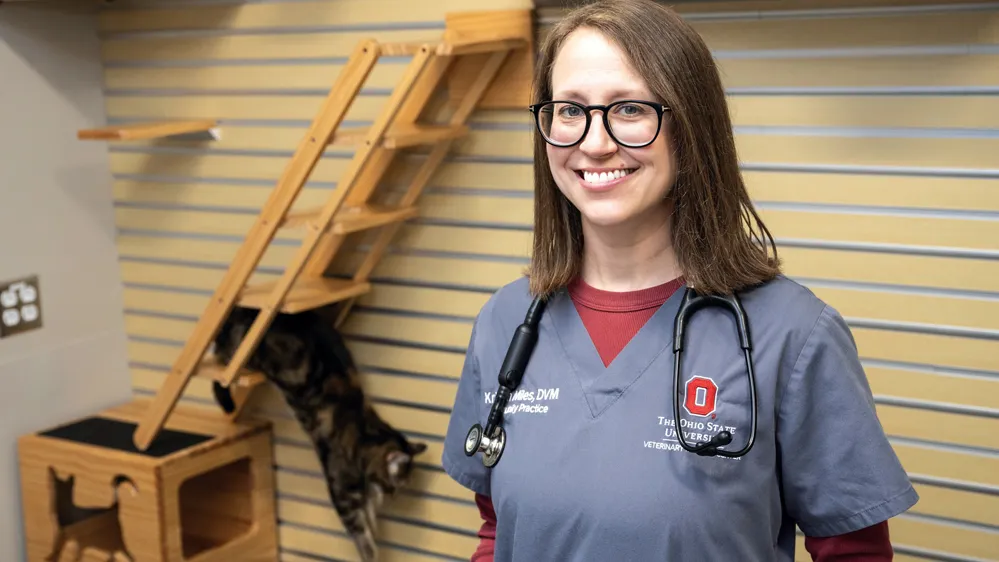
Dr. Kristen Miles, also an associate professor of practice, in a cat-centered exam room at The Frank Stanton Veterinary Spectrum of Care Clinic (Photo by Logan Wallace)
Veterinary medicine is about far more than treating sick animals. Preventive care, nutrition, behavior, client communication and advances in medical technology all play a role.
Kristen Miles ’11 DVM spent a decade in private practice before returning to Ohio State, where she trains future veterinarians while caring for companion animals. Her titles: medical director of primary care at Ohio State’s Frank Stanton Veterinary Spectrum of Care Clinic and associate professor of practice in the College of Veterinary Medicine. Miles’ expertise spans preventive medicine, client education and the everyday challenges facing pet owners and veterinary professionals.
Recently, she answered your questions.
-
What is a good tick prevention for dogs? — Greg Standley ’91
This question is especially timely. With serious tick-borne diseases such as Lyme disease becoming more prevalent in Ohio, it is important to protect dogs from ticks and fleas year-round.
There are several effective products, and the best choice often depends on your dog’s lifestyle, medical history and your preferences. Flea and tick collars, such as Seresto, can repel and kill ticks, but they must fit properly and maintain contact with the skin to be effective. Topical products may be helpful for dogs with food allergies or sensitivities that make flavored oral medications less desirable. Products such as K9 Advantix II and Vectra 3D help repel ticks and prevent attachment. Others, such as Frontline, kill ticks after they attach.
Chewables are also widely used. While they do not prevent attachment, they kill ticks quickly, reducing the risk of disease transmission. Approved oral products in the United States include Bravecto, Credelio (and Credelio Quattro), NexGard (and NexGard Plus) and Simparica (and Simparica Trio). These medications belong to a class of drugs called isoxazolines. More recently, an injectable called Bravecto Quantum became available and provides protection for 8 to 12 months.
While all approved flea and tick preventives are safe, no medication is without risk. Your veterinarian can help you choose the best product for your pet. Also remember that cats need year-round flea and tick prevention, too.
-
What was the coolest animal you ever got to treat? — Paul Mlakar ’94
For six years, while I was in small-animal private practice, I volunteered as a veterinarian for my local zoo. I had the opportunity to care for species including kinkajous, agoutis, a sloth and a porcupine. But I particularly enjoyed caring for the Eastern screech owl.
My interest in raptors began when I was a veterinary student volunteering at the Ohio Wildlife Center. There, I helped care for owls and hawks undergoing rehabilitation and gained an appreciation for their remarkable adaptations and resilience. I find them both beautiful and fierce, and they remain some of the most memorable animals I have worked with.
-
I have trouble giving my cat prescription calming medication before appointments. Do you have any advice? — Joan Slattery Wall ’89
As the owner of a very spicy cat who is also extremely difficult to medicate before veterinary visits, I completely understand this challenge. Fortunately, there are several approaches that may make the process easier.
Gabapentin, one of the most commonly prescribed medications for reducing stress before veterinary visits, is often dispensed as a capsule that can be opened and mixed into wet food, squeeze treats such as Churu or Delectables, tuna juice or even plain chicken baby food. Some cats are sensitive to the taste of the medication, however, and may refuse food that contains it. In those cases, hiding the capsule in a pill pocket can be successful. If the capsule size is problematic, your veterinarian may be able to prescribe a compounded tablet that is easier to administer.
For cats that cannot be pilled, liquid formulations may be an option. Some cats tolerate liquid medication administered by syringe, and compounded flavored liquids can sometimes improve acceptance (for either gabapentin or trazodone, and there is now a pregabalin liquid formulation as well called Bonqat). Compounding pharmacies can also prepare gabapentin as flavored tablets designed to be more appealing to cats.
If none of these options are successful, talk with your veterinarian. We can discuss other options, such as learning to use a pet piller. Some cats simply cannot be medicated at home despite everyone’s best efforts. In those situations, we can often develop alternative plans, including sedation after arrival at the clinic, to ensure the visit can still be completed safely and with as little stress as possible for both the cat and their family.
-
How do I know if my adult dog is a healthy weight? — Michael Newbern ’14
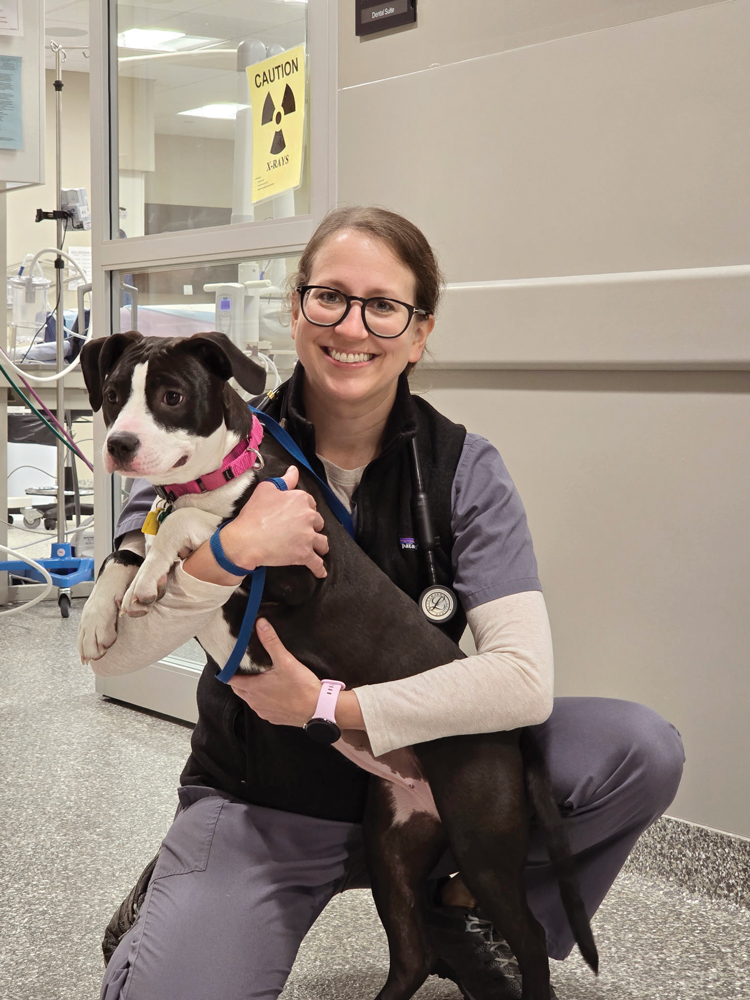
Dr. Miles holds her own pooch, Mookie. She’s also the proud owner of three cats. (Photo courtesy of Miles) One of the best ways is to have your veterinarian assess both their body condition score (BCS) and muscle condition. The BCS is a nine-point scale that evaluates body fat. In dogs with an ideal body condition score of 4 or 5, the ribs are easily felt with minimal fat covering them. The spine and hips should not be prominent but should still be palpable without excessive fat coverage. The waist should be noticeable when viewed from above, and the abdomen should tuck upward when viewed from the side. Similar principles apply to cats, although the abdominal tuck is often less obvious. A healthy cat should have little to no abdominal fat pad.
If the ribs, spine and hips are overly visible or easy to feel, a pet may be underweight. On the other hand, if these are difficult to palpate because of excess fat, the pet may be overweight. Learning to assess your pet’s body condition at home can be helpful, but regular veterinary evaluations remain the best way to monitor your pet’s weight and overall health.
-
As older pets have decreased kidney function, how can kidney failure/decline be treated? — Sherry Browning ’71
Chronic kidney disease (CKD) is one of the more frustrating conditions veterinarians manage because it is not curable, but it can often be successfully controlled. Early detection is important and frequently occurs through routine screening bloodwork and urinalysis, which may reveal persistently elevated kidney values and dilute urine. In some cases, additional testing identifies an underlying cause, although treatment recommendations often remain focused on long-term management.
Once CKD is diagnosed, your veterinarian will typically perform additional testing to determine the stage of disease and look for complications such as high blood pressure and excess protein loss in the urine. Both conditions can contribute to disease progression if left untreated. Treatment recommendations are then tailored to the individual patient and the stage of disease.
Management often includes a therapeutic kidney diet, which is formulated with restricted levels of phosphorus to support kidney function. Maintaining good hydration and providing continuous access to fresh water are also important. Pets with high blood pressure may require medication to control it, while those with excess urinary protein may benefit from medications and additional monitoring. Some patients may also need treatment for complications such as anemia or nausea.
Ongoing monitoring is an essential part of managing CKD. Follow-up testing may be more frequent when medications are first started or adjusted, particularly for conditions such as hypertension or proteinuria. Once stable, many pets are monitored every three to six months, although the exact schedule depends on their disease stage and overall health. In some cases, referral to a veterinary internal medicine specialist may also be beneficial.
Although chronic kidney disease cannot be cured, early diagnosis and appropriate management can help maintain a good quality of life for many months or even years. This is one reason I strongly encourage annual or biannual wellness testing, particularly as pets age, so that changes in kidney function can be identified as early as possible.
-
What is the best food for dogs short of making it yourself? — Mike Monnin ’85
This answer may be disappointing: There is no single “best” dog food. Many reputable companies produce high-quality diets backed by extensive research, rigorous quality control and expertise in nutrition. The most trustworthy employ board-certified nutritionists, own their manufacturing facilities and support their products with peer-reviewed research.
When discussing nutrition with clients, I look at the whole picture, including the pet’s age, activity level, lifestyle and medical conditions. Rather than recommending one brand, I encourage owners to choose a diet formulated for their pet’s life stage and produced by a company that meets these high standards.
The World Small Animal Veterinary Association (WSAVA) offers excellent resources to help pet owners evaluate pet foods online. Their Nutrition Toolkit includes helpful guides such as Interpreting Pet Food Labels and The Savvy Dog Owner’s Guide to Nutrition on the Internet.
If you would like more personalized guidance, Ohio State’s Veterinary Medical Center offers access to a board-certified nutritionist through its Companion Animal Nutrition Support Service. Learn more at the OSU Companion Animal Nutrition Support Service.
Ohio State’s Veterinary Medical Center
For primary care appointments for your dog or cat, or to learn more about services at the Frank Stanton Veterinary Spectrum of Care Clinic, call 614-292-1573 or visit vmc.vet.osu.edu/primarycare.