Ness Shroff, the Buckeye teaching AI to serve us
From resilient networks to cross-country partnerships, the professor brings researchers together to create tech that makes daily life safer.
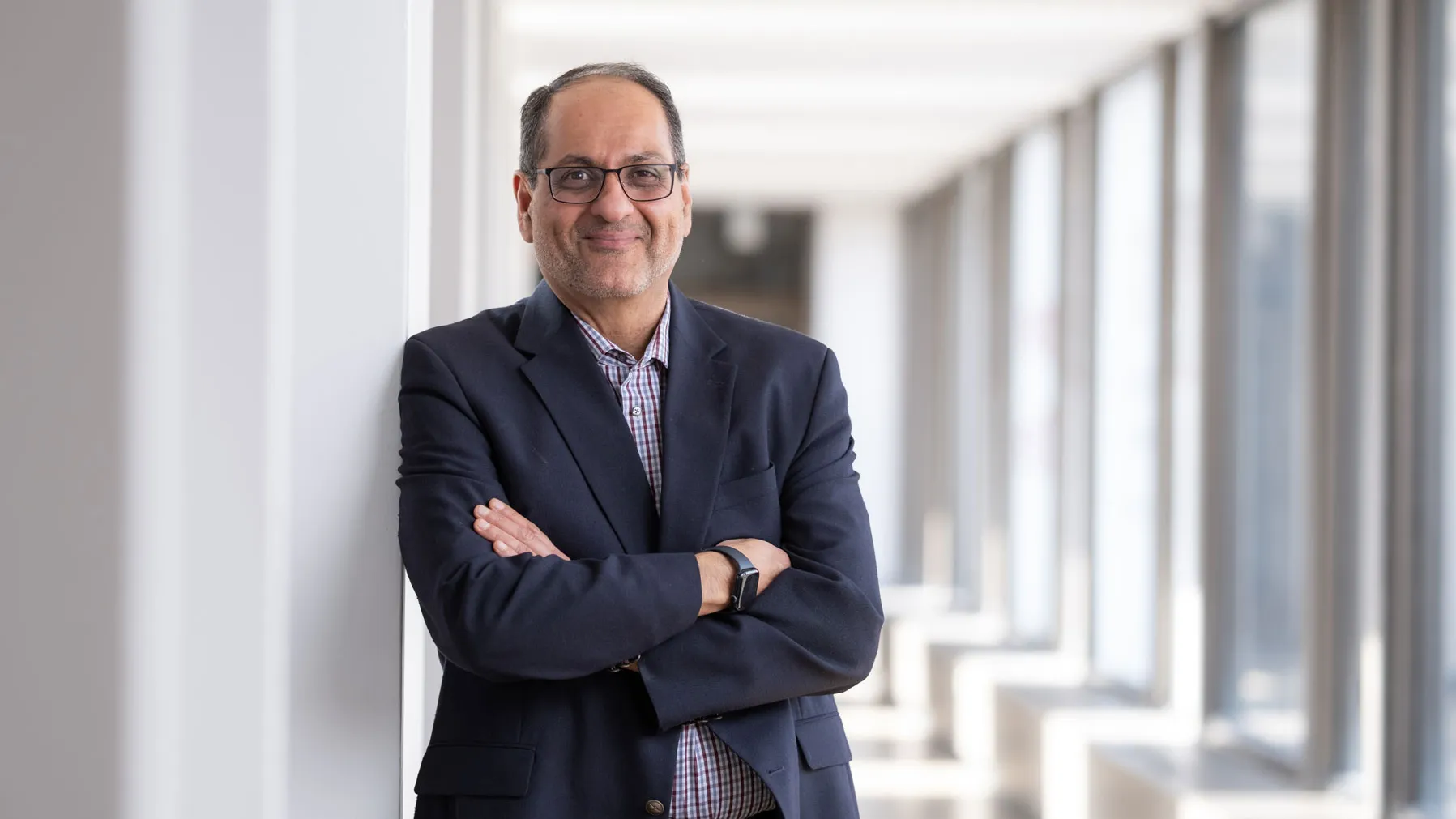
Professor Ness Shroff, an Ohio Eminent Scholar, focuses on the “edge” of networks, or the space outside data centers where AI devices, intelligent transportation, remote health care, distributed robotics and smart aerospace live. (Photo by Corey Wilson)
Artificial intelligence is often framed as detached and impersonal. Ness Shroff sees it differently.
He talks about restoring communication after natural disasters. Helping doctors diagnose disease faster and more accurately. Giving educators better tools to reach students who might otherwise be left behind. For Shroff, one of Ohio State’s most influential AI researchers, artificial intelligence isn’t about machines. It’s about people.
Warm, quick to laugh and disarmingly approachable, Shroff upends the stereotype of the cloistered technologist. When he discusses AI, the conversation rarely turns to code. Instead, it centers on impact, on how technology can connect, empower and protect.
“Ness is a deeply caring human being,” says Distinguished Professor Kaushik Chowdhury, a longtime colleague and friend at the University of Texas at Austin. “People often think of AI as cold, calculating machines. But these are human endeavors that require human vision. And I can’t think of anyone more qualified to bring people together around that vision than Ness.”
Shroff is a professor of electrical and computer engineering and computer science and engineering, an Ohio Eminent Scholar and an internationally recognized expert in AI and networking. His work has made him a voice in Washington, D.C., where he has advised on national AI policy and investment. It has also positioned him to lead two ambitious Ohio State-based initiatives.
This fall, Shroff was selected to direct the new AI(X) Hub at The Ohio State University, an initiative designed to unite researchers, entrepreneurs and AI experts to accelerate discovery across disciplines. At the same time, he continues to lead AI-EDGE—one of two National Science Foundation AI Institutes based at Ohio State—which he has directed since its inception in 2021.
Video: NSF AI Institutes at Ohio State

In this 3-minute video, AI-Edge leader Ness Shroff and ICICLE leader DK Panda, another star researcher at Ohio State, explain how their NSF AI Institutes focus on improving the future. ICICLE stands for Intelligent Cyberinfrastructure with Computational Learning in the Environment.
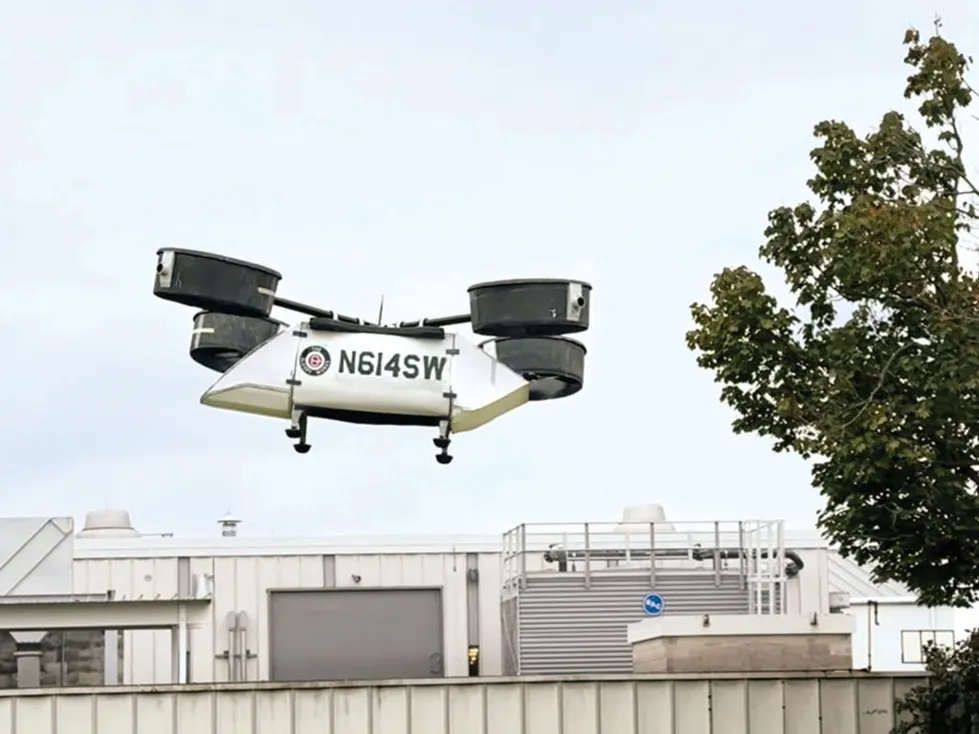
AI-EDGE (Artificial Intelligence for Edge Networks and Distributed Intelligence) focuses on advancing the technologies behind the wireless systems we rely on every day, from smartphones and telehealth platforms to autonomous vehicles and robotics. The work includes developing next-generation 6G-and-beyond capabilities and creating networks that are more secure, resilient and even self-repairing.
“We already have technology that has revolutionized the way we live,” Shroff says. “Now we have the opportunity to push it further, to make it more reliable, more intelligent and ultimately more helpful in people’s daily lives.”
The institute brings together national experts from research universities, government laboratories and private industry, all working toward a shared goal: ensuring U.S. leadership in next-generation edge networks.
“The institute has fostered collaborations that never happened before,” says Chowdhury, research lead within AI-EDGE and Chandra Family Endowed Distinguished Professorship in ECE. “Ness designed the institute around end-to-end problems. Whatever theory or experimentation we’re doing, it has to connect to a real challenge we’re trying to solve.”
That emphasis on translation, moving ideas from theory to practice, is a defining feature of Shroff’s leadership. “It’s not academic exercise for its own sake,” Chowdhury says. “It has to benefit someone. That message comes directly from Ness, and everyone aligns with it.”
Shroff is bringing that same philosophy to Ohio State’s AI(X) Hub, or AI to the power of X. The initiative is designed as a campuswide crossroads, where AI experts work side by side with scholars in medicine, engineering, agriculture, the social sciences and the humanities. In November, Ohio State announced plans to hire 100 new tenure-track faculty with AI expertise, joining the more than 300 AI scholars already on campus.
“Essentially, we are creating an AI brain trust,” Shroff says. “If you think about all the great researchers we have at Ohio State, in very different domains, they may not be experts in using AI tools for their research.
“We want AI experts deeply interacting with experts in their domains to create lifesaving therapies, new approaches to agriculture, answers in archeology, you name it.”
Former President Carter described the AI(X) Hub as “a catalyst for groundbreaking research and transformative innovation in AI,” and a cornerstone of the university’s vision to lead in artificial intelligence.
Shroff believes Ohio State is positioned to do just that, not simply as an academic leader, but as an institution focused on improving lives. “To have an environment like this allows us to push boundaries,” he says. “Whether it’s dance choreography, astronomy or medicine, there are so many opportunities to work together on problems that truly matter. It’s an exciting time.”