A Buckeye researcher redefines drug design
With AI models that craft and refine new molecules in seconds, Xia Ning ’24 MBA is helping transform how future therapies take shape.
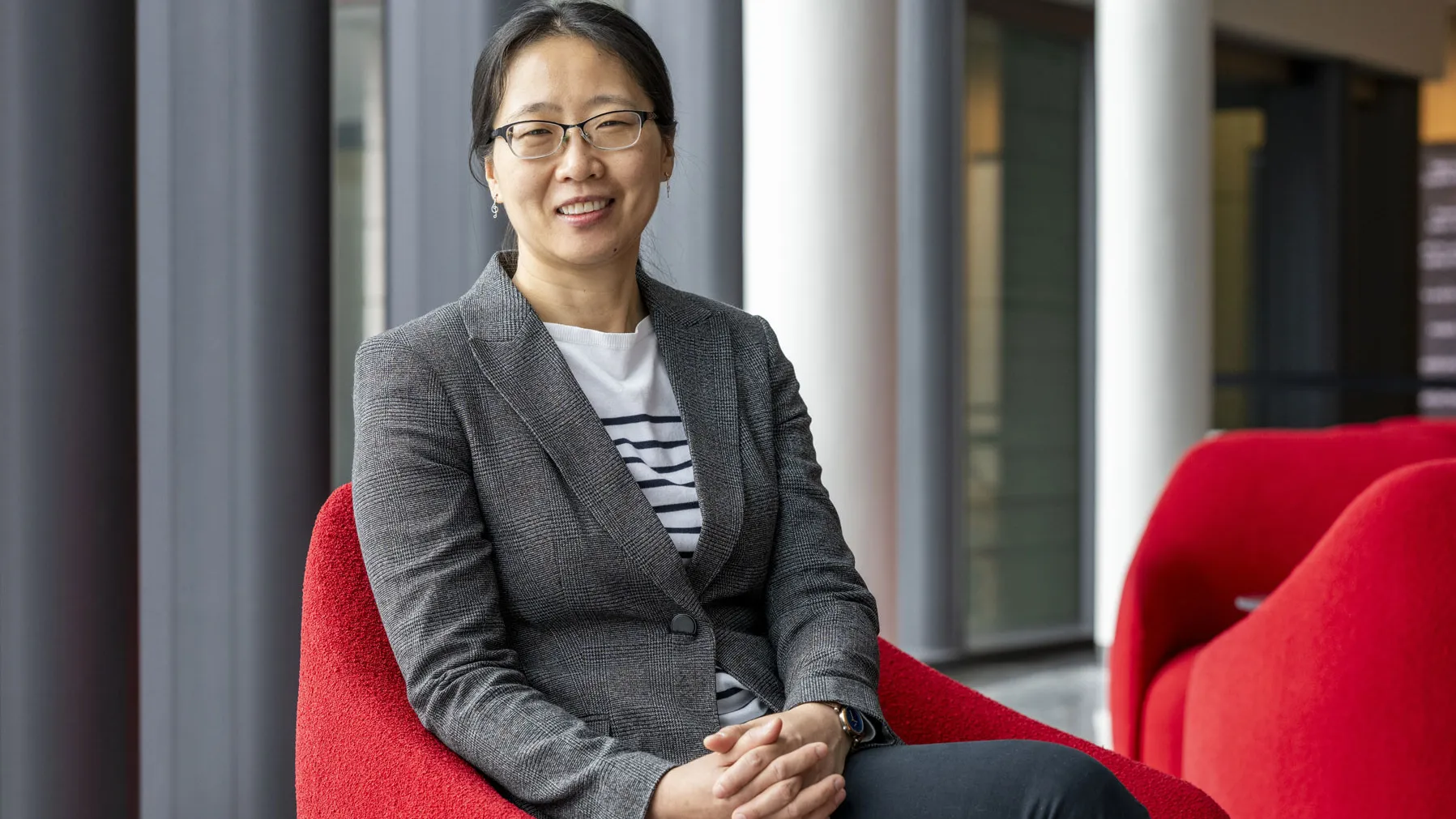
Ohio State’s Xia Ning also investigates using AI to make health records more impactful and to predict Alzheimer’s. (Photo by Logan Wallace)
For scientist Xia Ning ’24 MBA, artificial intelligence is a true cognitive partner. She and her colleagues are using the powerful tool to transform how researchers identify promising new drug candidates. “Science needs AI as much as it needs human intuition and wonder,” says Ning, a professor of biomedical informatics and computer science and engineering. “And it needs researchers to understand and confirm the veracity of new findings.”
Traditionally, finding a new drug is slow, expensive and uncertain. The reason: Human scientists can examine only so much information at once, resulting in many potentially useful compounds being overlooked. Using advanced AI, however, Ning has greatly accelerated that process. She and her team developed code that asks AI to question, explore and evaluate the potential of promising drug candidates for existing diseases. Then they asked it to parse vast sets of biological and chemical data, synthesizing existing knowledge to reveal new possibilities with higher success rates.
The result is a much faster and more accurate process. With AI, preclinical drug discovery is shortened to minutes instead of months or years.
Ning’s generative AI model, DiffSMol, boasts a 61.4 percent success rate when it designs 3D molecules that could lead to future drugs. Prior research attempts achieved a success rate about 12 percent of the time, according to a study published last year.
Video: See Ning explain it

This 7-minute video shows Professor Xia Ning explaining her drug development AI in a Research and Innovation Showcase spotlight talk at Ohio State. She details how efficient her tool is and how real drugs can be created as a result.
And Ning and her team think the next step their model can achieve is modifying proposed molecules to have more favorable druglike properties, affecting aspects like their toxicity or how easy they are to produce in the lab.
“Now we use AI to go beyond looking for potential candidates and determining good options that need to be evaluated,” Ning says. “It develops sound ones from the very beginning.”
Drug discovery is a field rife with hurdles like lengthy development paths, extremely high failure rates and safety and toxicity issues. Which makes Ning’s innovations so powerful. “If the molecule is good but not good enough, we don’t want to change its entirety, but just a small portion to improve and retain the desired properties,” Ning says.
“Medicinal chemists used to manage this task, but with AI, it takes less than a second. When we presented this to our collaborators in the pharmaceutical field, they were very surprised.”
Humans still evaluate and validate AI design and results, but the tech helps Ning and her team create tools to improve clinical care. Ning’s other AI projects include helping health practitioners identify the most vital information from electronic health records and developing models that can predict Alzheimer’s disease years before symptoms appear. A $3.7 million grant from the National Institute on Aging is supporting the latter project, which began with a $50,000 internal President’s Research Excellence Accelerator Award in 2023.
Professor Ness Shroff leads the university’s recently launched AI brain trust, AI(X) Hub, which brings together subject matter experts, AI scientists and learners collaborating on complex problems. Ning heads AI for Health, one of the six strategic pillars of the innovative AI(X) Hub ecosystem.
“As her partner, AI helps comb vast amounts of data for insights and supports informed decision-making that opens new doors,” Shroff says. “This leads to breakthroughs in early disease detection, more effective drug discovery and clinical applications that will have profound and lasting impacts.”
AI’s journey continues to expand deep engagement and wonder in ways that go far beyond the capacity of a single human mind. “AI reminds us that discovery embodies constant change,” Ning says. “Being open to seeing beyond what we know and do not know augments our ability to translate discovery into breakthrough solutions.”
Information from “Generative AI on track to shape the future of drug design,” a story written by Tatyana Woodall ’19, ’21, was used in this story.