A long line of strong women powers this talented artist
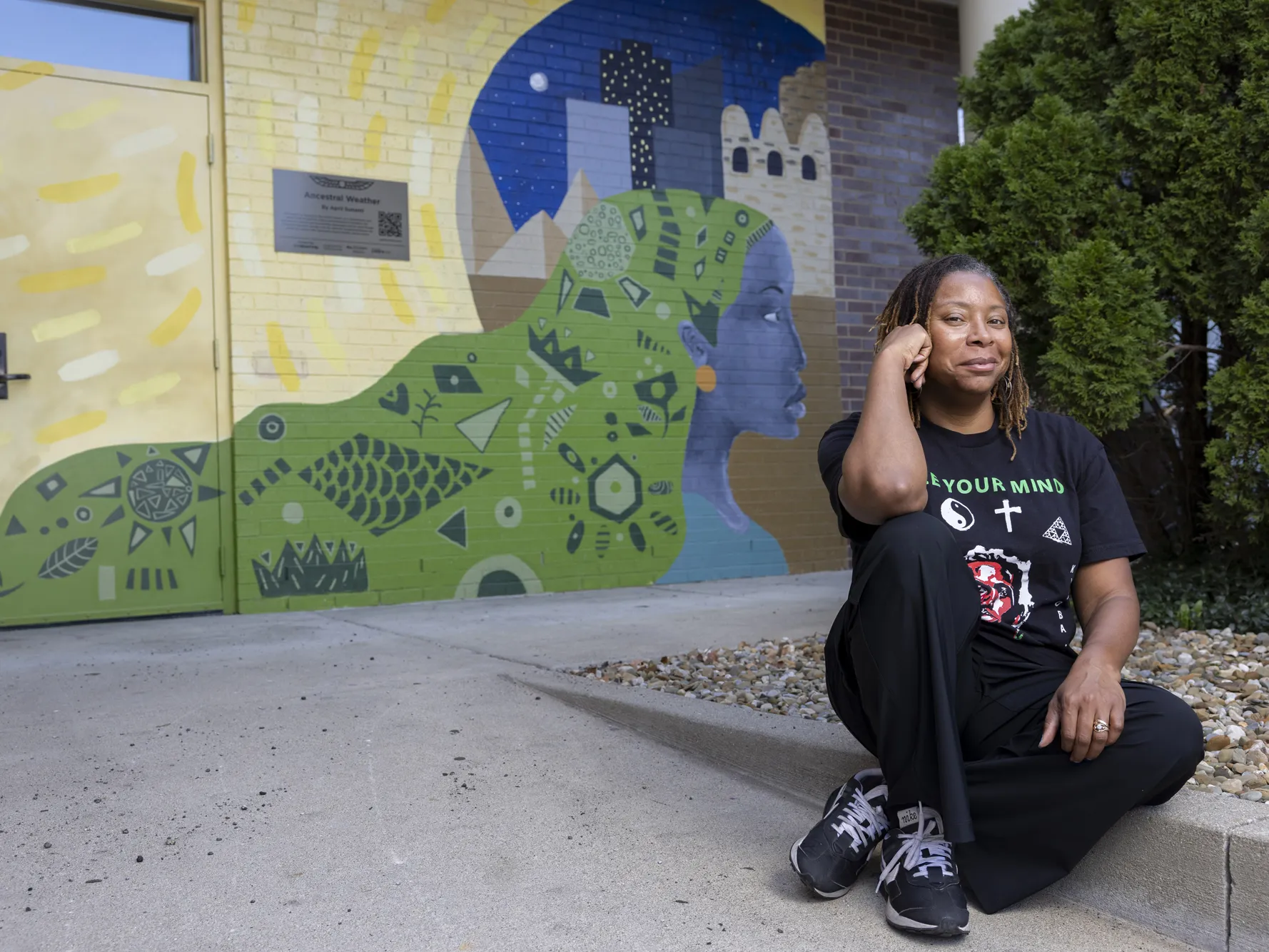
April Sunami ’02 is a force in the Columbus art scene. Through portraits, murals and more, she influences the thinking of many.

Strong women. Many came before April Sunami ’02. Many will come after. And the work of this strong woman—a mixed-media painter, muralist and self-described cultural producer—has portrayed hundreds more.
Focusing her attention and paint brushes mainly on Black women was a choice Sunami made shortly after earning her bachelor’s degree in art history from Ohio State in 2002. Her college years had been full of discovery, and they helped shape who she is, what she does and how she sees the world around her.
“The art history department was amazing. It is my first love, art history,” she says, quickly recounting other experiences that widened her universe. “Have you ever taken a class where you feel like your head just exploded? It changes your world forever. You read a text for that course and everything changes.”
That happened in a class on African American female writers, focusing partly on Alice Walker and what became one of Sunami’s favorite books, “Possessing the Secret of Joy.” Anthropology courses, an African and African American survey class, peace studies (what she calls “the foundation of me becoming a critical thinker, unlearning and learning a bunch of things.”) They all contributed to the woman Sunami is today.
So, too, have her resilient role models, including her mother, the late Mary Sturkey, and two sisters, Stephanie and Phaedra. A 911 operator for the Cincinnati police and fire departments, Mary Sturkey “talked to people on the absolute worst day of their lives. She has always been an inspiration. I’m immensely proud of her. She’s continued to be an influence even though she’s not here anymore.”
William and Mary Sturkey always were supportive of their daughters and taught them to be proud of themselves and their heritage. That heritage led Sunami to base much of her art on West African queens and deities.
“That’s where my ancestors came from. That’s my motherland. It’s the piece of identity I’ve yearned for. My parents were really lovely and always instilled this sense of pride in who I was and my heritage.
“But the messages I got from school and other institutions were that, as an African American, my history began here, with slavery. That’s a false narrative, and it took me a long time to unlearn that and really do the research. That led me on this path of figuring out what pre-colonial Africa looked like. It was a way of reclaiming this great past, this rich history.”
In 2022, Sunami was invited to accompany a group from Columbus’ Thiossane West African Dance Institute to Senegal and Gambia, a life-changing experience that deepened her appreciation for her ancestry. Among their stops was Gorée Island, off the coast of Dakar, Senegal. The largest slave-trading center on the African coast from the 15th to 19th century, it is now a UNESCO World Heritage site.
“They would capture people, put them in these pens basically, until there was a ship that came over and there were enough of them to fill the ship,” Sunami says. “I remember very distinctly going into one of these rooms, and there was a little slit in the wall. And that was the only slit for ventilation that they would have. They would pack human beings into this room, as many as they could fit in there, and shut the door.
“All I could think was, ‘I cannot breathe. I can’t breathe.’ I stepped in the room, and I stepped out really quickly. I’m in the space where all this happened. I felt dizzy. I felt lightheaded. I felt like time and space faded away. I had this image of all of these people locked up in this room, unable to breathe. Then I thought about here and now, in this moment from 2022, fresh off the murder of George Floyd and many others to follow. That was a plea of many folks, ‘I can’t breathe.’ I just made this connection, how breath is an essential life force that connects all of us.”
Making and sharing connections is part of Sunami’s role as what she calls a “cultural producer,” someone who can influence perception through her art. “I love learning. Learning about not only art but about the world, and every once in a while, I get lost in some new obsession,” says Sunami, her family’s youngest member.
“I was encouraged to be intellectually curious about the world. I had that space and that freedom. I was left alone with my own imagination. In some ways, it forged me to be an explorer of sorts.”