He made a career of sharing Ohio State discoveries
Jeff Grabmeier ’90 MA accidentally stayed at the university, but he very purposefully spread our meaningful research far and wide.
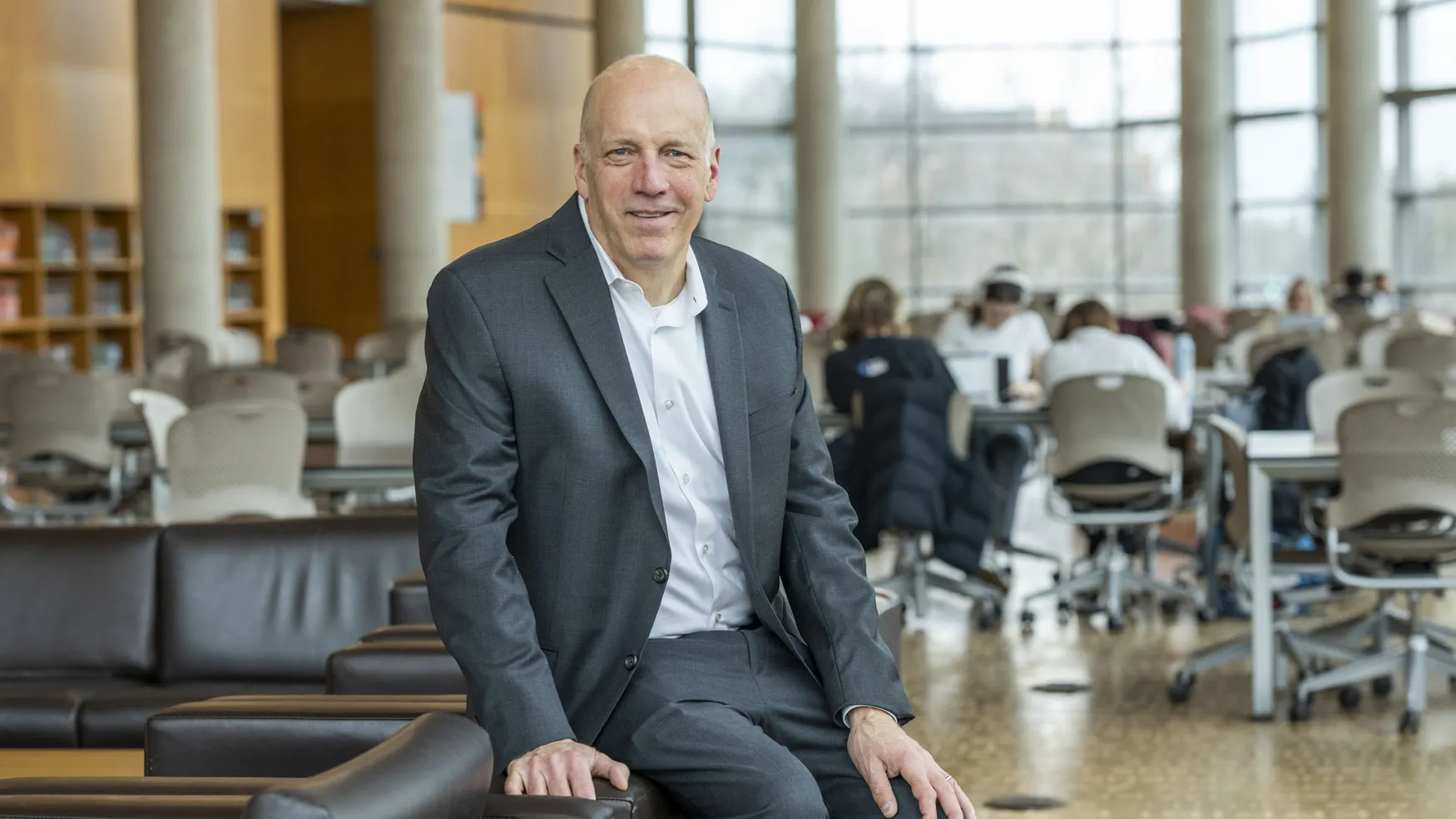
Jeff Grabmeier, in Thompson Library, spent 40 years at Ohio State, where he pioneered writing about social sciences at universities. (Photo by Logan Wallace)
When I accepted a job as a science writer at Ohio State in 1985, I made a promise to myself: I would stay at least long enough to earn a master’s degree in political science. I thought it might be helpful in my long-term goal of becoming a newspaper political reporter.
I earned that degree in 1990, but somehow, I never found a reason to leave. It turned out that I had found my dream job. Now, four decades later, I have officially retired, and looking back, I could not have scripted a better career for myself than the one I had.
Here’s why I had the best job in the world: I got to talk to more than 1,000 brilliant and dedicated faculty about the brand-new cool science they did, and then I got to write about it and share it with the public. Every study I wrote about was new and different and provided me with unique challenges.
My time at Ohio State was like the saying about parenting: The days were often long, but the 40 years I spent there were short.
As a young newspaper reporter with just a couple of years’ experience under my belt, I didn’t realize that Earle Holland, the man who hired me to work at the university, was already a legend in the science writing community. He was one of the first people to establish science writing as a job at a university.
What’s more, Holland made me one of the first university science writers to specialize in the social sciences. My job was to take the studies conducted by our researchers in fields like psychology, sociology, political science and business and write accessible summaries, just like you would find in a mainstream newspaper or magazine. In the beginning, long, long ago, we snail mailed those news releases to reporters and editors, in the hopes of getting them to cover the research.
Writing about social science research in a serious way was novel at the time, and I had to figure out what types of studies resonated with the public. One thing I learned early through my own experiments was that reporters and the public weren’t just interested in studies with results that upended conventional wisdom. They also were interested in research that confirmed things people already believed but had never been scientifically tested.
This went against the journalistic notion that “dog bites man” wasn’t a story—that readers only cared about “man bites dog.” Our “dog bites man” stories were such a departure that The Scientist magazine interviewed me in 2007 about Ohio State’s news releases that seemingly confirmed the obvious, like the one I wrote with the headline “You don’t have to be smart to be rich.” The Scientist called such news releases “selling the self-evident.”
But the article also admitted our success: The “You don’t have to be smart to be rich” story was picked up by The New York Times, The Wall Street Journal, the Associated Press and many other media outlets.
While the first couple decades of my career were focused on persuading news outlets to write about Ohio State research, things changed as traditional media began to decline and the number of science writers covering university research plummeted.
As a result, my colleagues and I shifted a portion of our attention to writing directly for the public and attracting readers to our stories on the Ohio State News website. With the excellent and interesting research done by our faculty, we have had our fair share of viral hits.
The biggest highlight came in October 2021, when science stories on Ohio State News attracted more than 1 million unique visitors. A psychology study about adult children estranged from their parents and research on rattlesnake biology were the biggest hits, drawing more than 860,000 unique visits.
Not many months will be like that, but it is gratifying to know how many people are interested in the research done by our Ohio State faculty.
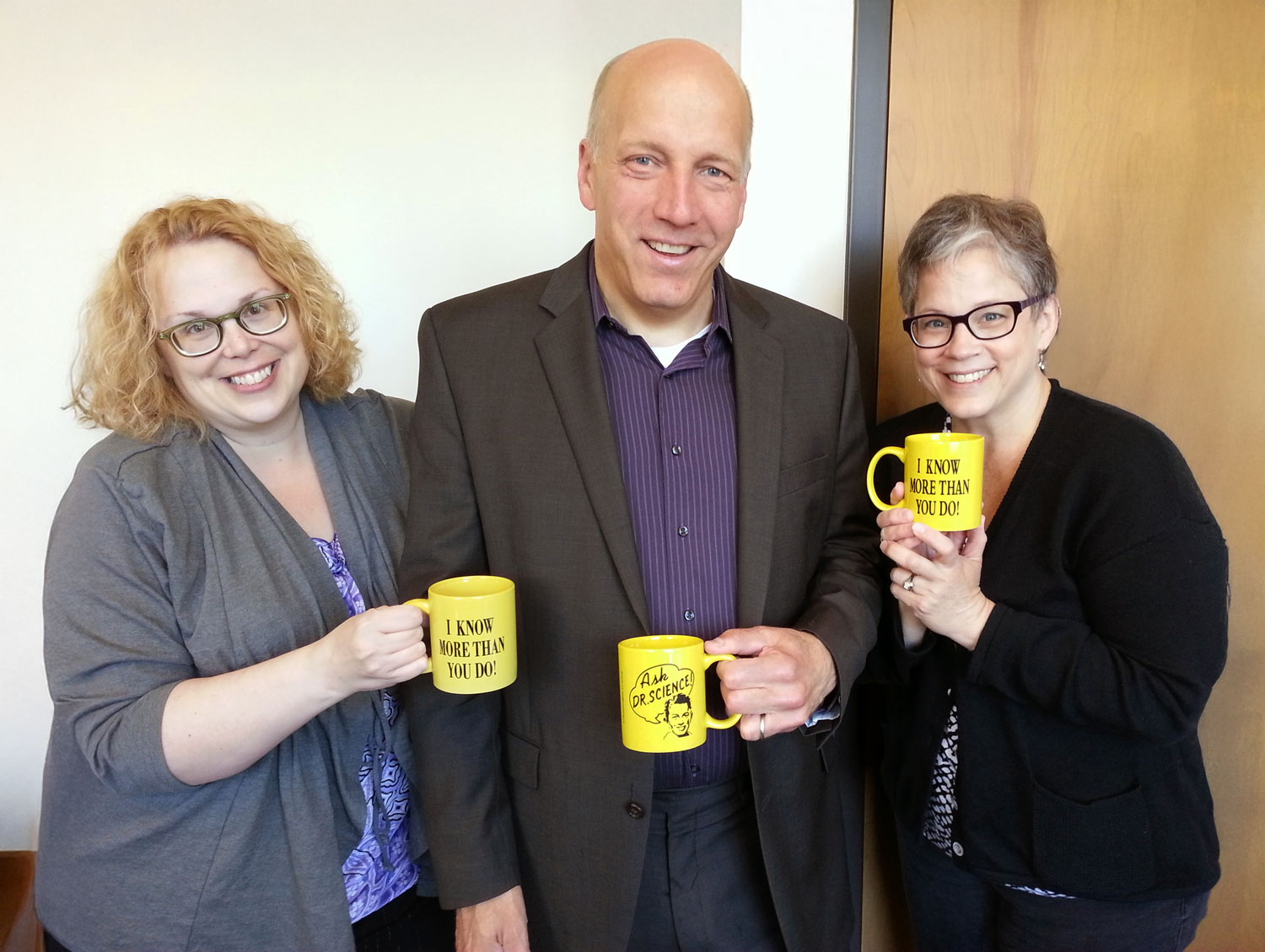
As I got closer to retirement, many people began asking how I had stayed at this job for 40 years. The answer is simple: the people. During my career, I went from simply writing about science to becoming the university’s director of research communications, which gave me the opportunity to lead and support other dedicated science writers in our goal to promote Ohio State’s research success.
And of course, there are the faculty whose work has inspired me. I’ll remember Brad Bushman and his work at the Driving Simulation Lab studying how having weapons in a car can lead to more aggressive driving. I’ll remember Hollie Nzitatira’s heartbreaking work on the genocide in Rwanda. I’ll remember Bruce Weinberg’s research on creativity that studied Nobel Prize winners. I’ll remember Sarah Schoppe-Sullivan’s work on co-parenting and how mothers and fathers can work together to best raise their children.
It is truly amazing what these professors and many other faculty have discovered. In 40 years, I have witnessed Ohio State go from a very good research university to one that is ranked in the top 15 by the National Science Foundation. I feel fortunate to have been along for the ride.
During his career, Grabmeier was elected a fellow of the American Association for the Advancement of Science in 2009 and awarded The Ohio State University Distinguished Staff Award in 2015. He reports that he will spend his retirement pursuing his hobby of birding.