Where data meets discovery for global conservation
Through bold collaboration, Ohio State’s Tanya Berger-Wolf is advancing tools that offer faster ways to understand species and guide smart conservation decisions.
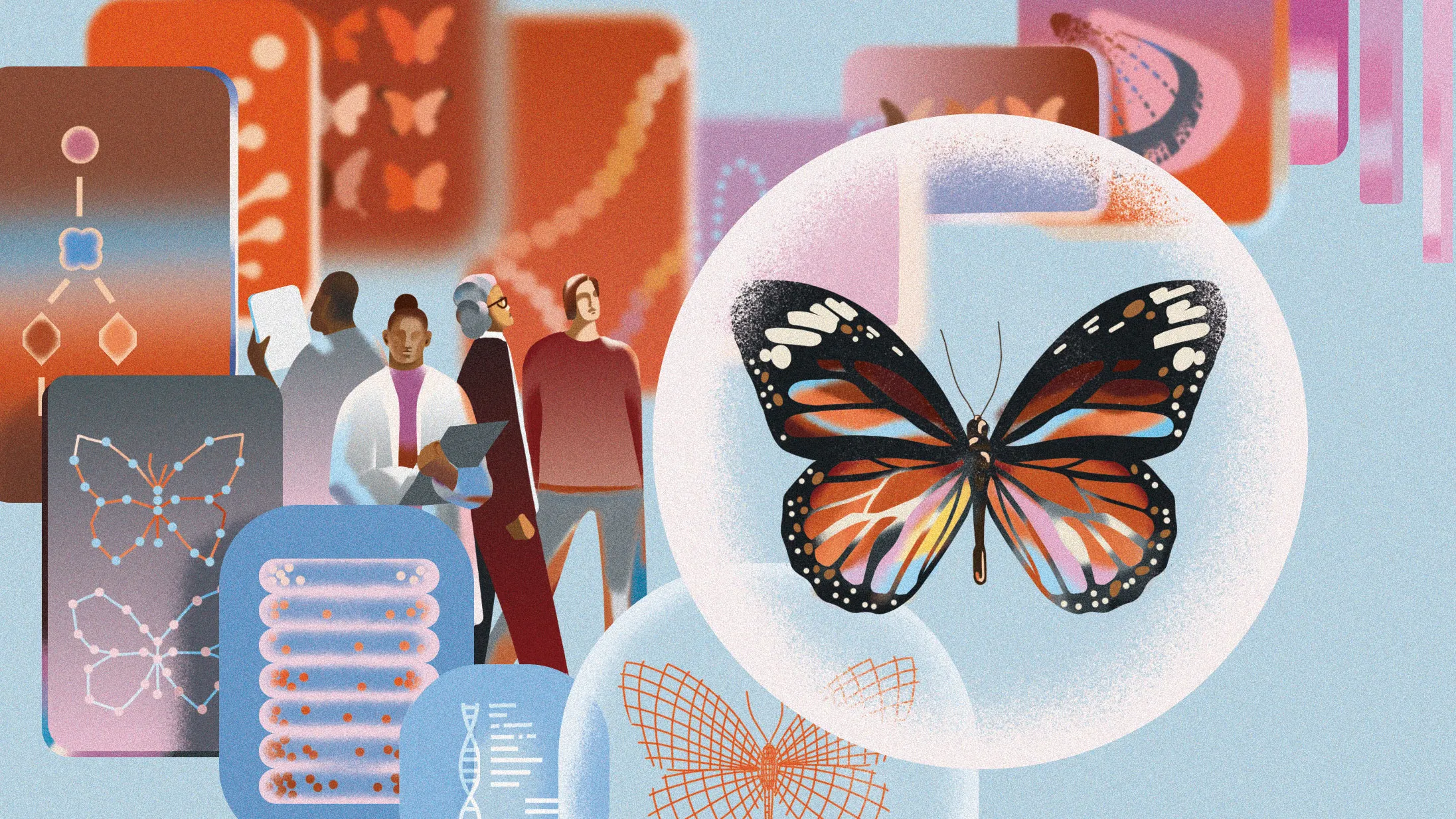
(Illustration by Olga Aleksandrova)
Imagine pioneering a new field of science. One with the potential to save endangered species. Protect habitats. Even develop apps that allow hikers to identify bugs and plants in Ohio’s backwoods. Sounds lofty. But that’s exactly what Ohio State’s Tanya Berger-Wolf is doing. That’s her contribution to the world.

A computational ecologist and professor, Berger-Wolf’s work combines artificial intelligence and biology to give researchers novel insights into animal behaviors, critical knowledge that can be used toward protecting biodiversity and conservation efforts.
“We are in the middle of a biodiversity crisis, what has been termed the sixth extinction, and AI gives us a powerful tool to track and protect species,” Berger-Wolf says. “By using AI, we can make better conservation decisions before it’s too late.”
Her years of work in this space culminated in 2021 with the inception of the National Science Foundation-funded Imageomics Institute, based at Ohio State and boasting top computer scientists, biologists and ecologists from around the nation.
This new scientific field uses vast supplies of worldwide images and videos to train machine learning algorithms to provide insight into animal and plant traits for biodiversity and conservation purposes.
“I fundamentally believe that it’s not technology alone, it’s not humans alone that are going to come up with the solutions,” says Berger-Wolf, director of Ohio State’s Translational Data Analytics Institute. “To solve these big challenges we’re facing, it’s a partnership between technology and humans addressing these challenges together.”
In just a few short years, Imageomics has produced results in startlingly quick fashion. For example, two of her grad students, Samuel Stevens ’21 and Lisa Wu, designed an AI-powered image-recognition tool called BioCLIP, which has since scaled up to BioCLIP2, that is being used to detect highly detailed animal traits for species classification.
Video: Imageomics explained
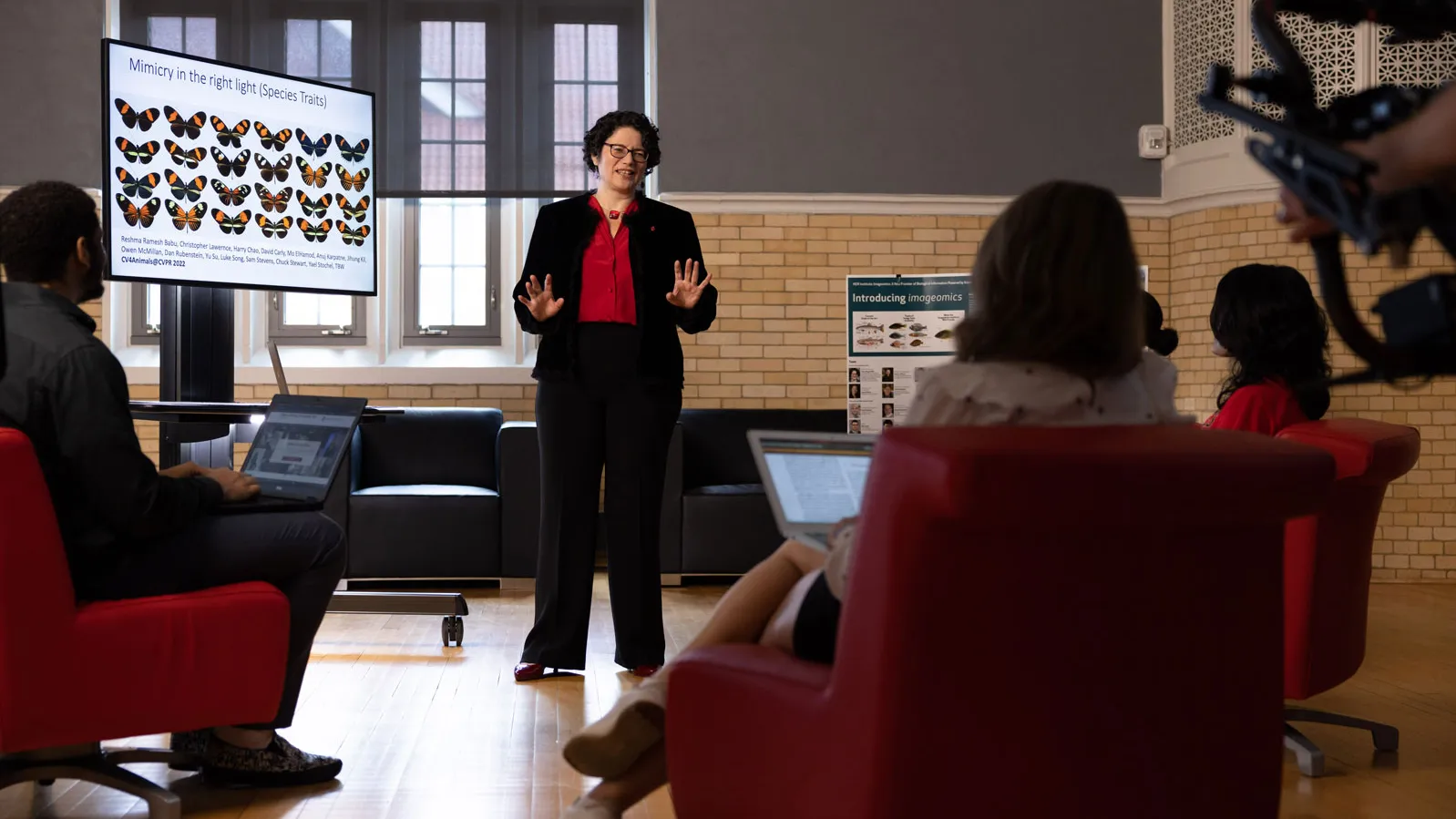
This 3-minute video shares, in part, how your vacation photos can contribute to Tanya Berger-Wolf’s groundbreaking work.
It’s an example of a tool that offers rapid understanding. For instance, through BioCLIP2, an Ohio farmer will soon be able to take a picture of a tick, upload it to an app on a phone and know its behaviors and possible diseases. Currently, the process for deciphering a tick species in Ohio is a lengthy one involving health departments.
“We very intentionally built a great team, a community of experts in their field who are passionate about science and collaboration,” she says. “And we’re starting to make discoveries humans have long overlooked.”
In 2023, Berger-Wolf also began leading an additional conservation-aimed effort, the AI and Biodiversity Change (ABC) Global Center, funded by the U.S. and Canada. The Center is tasked with developing AI tools that will help us understand climate impacts on biodiversity.
“Tanya’s at the center of everything,” says Justin Kitzes, an associate professor of biological sciences at the University of Pittsburgh and a research co-lead for the ABC Global Center. “In a lot of ways, she’s field-defining. She’s establishing spaces, carving out new areas that people can then enter to do the work we want to do.
“To me, the highest praise you can give a leader is that they are working to define a new field, this intersection of AI and biodiversity science.”
The impact isn’t merely theory. A landmark study led by Kitzes and co-authored by Berger-Wolf, published in the prestigious journal Nature in 2025, detailed how AI is closing major gaps in our understanding of animal species, habitats and ecological interactions.
“Tanya sees things can be better, and it’s important for her to accomplish that,” Kitzes says. “It’s why she’s had such a large impact. She wants the world to be a different place when she’s done.”