The long reach of hope
Ohio State’s Sameek Roychowdhury ’98, ’04 PhD, ’06 MD is bringing lifesaving clinical trials to rare-cancer patients wherever they live.
A breakthrough cancer treatment can be a bit of a magic trick.
“If you’re trying to do something innovative and people say that’s impossible, then you know you’re on the right track,” says Dr. Sameek Roychowdhury ’98, ’04 PhD, ’06 MD. “If it’s already been done, it’s not innovative. You haven’t shown them any magic.”
Throughout his time at Ohio State, the highly regarded precision cancer specialist has pulled plenty of rabbits out of his hat. But his latest trick might be his most impressive. In May 2025, Roychowdhury opened the world’s first telemedicine clinical trial for cancer patients.
“It’s so new, the words we’ve been using to describe it keep changing,” he says of the trial. “We’ve called it a ‘telemedicine clinical trial’ and a ‘telehealth clinical trial,’ or a ‘decentralized clinical trial,’ but nobody knows what that means. I like ‘nationwide fully remote clinical trial.’ That makes sense to me, but we’re still workshopping the name.”
No matter what you call it, the idea is a game changer. Clinical trials are how cancer treatment moves forward, but they traditionally require a slow, expensive and painstaking process. A scientist opens a trial and then accrues patients to test a new drug or treatment in 15, 20 or even more comprehensive cancer centers simultaneously. This costs tens of millions of dollars and often prevents new clinical trials from getting off the ground, especially for rare forms of cancer. The traditional process also means patients living closer to test sites get the most access to life-extending and life-saving trials, and the hope they can inspire.
So Roychowdhury innovated. While his remote trial is offered only at Ohio State’s Comprehensive Cancer Center – James Cancer Hospital and Solove Research Institute (OSUCCC – James), patients anywhere in the country can participate from where they live. Roychowdhury and his team connect and communicate with patients online, oversee their treatment from Columbus, prescribe and send drugs to them in the mail, and coordinate routine standard of care, scans and blood tests with local oncologists.
“Sameek has shone the light on the fact his concept of a telemedicine clinical trial is possible,” says Dr. David Cohn ’20 MBA, the chief operating officer of OSUCCC – James. “And once you know something is possible, that’s when the floodgates open and you see a rapid expansion and step forward.”
Stefanie Balm is one of the first participants in Roychowdhury’s new trial. In 2023, the resident of Coeur d’Alene, Idaho, was diagnosed with a rare form of pancreatic cancer fueled by a genetic mutation in a protein that helps regulate the growth of muscle and tissue cells throughout the body. “There just wasn’t much hope,” Balm says. “I had just turned 43, was married with three kids; I was just doing life. I couldn’t believe this was happening to me.”
Today, Balm feels differently. She isn’t cured, but her cancer is under control. And hope has returned. “This is now the first time in the three years I actually feel normal,” Balm says. “I have so much gratitude for Sameek and his team.”
If Roychowdhury’s big idea continues to spread, so may that hopeful feeling.

After two rounds of chemotherapy failed to stop cancer growth for Idaho resident Stefanie Balm, top left, her doctor found Roychowdhury and his trial. Now she takes medication mailed to her, meets with the Ohio State team virtually, top right, and has scans and checks at her local doctor’s office. (Photo by Corey Wilson)
The making of a scientist
Roychowdhury has long been known for ingenuity, a quality Ohio State cultivated in him as a student and a faculty member. After graduating from what was then known as Hilliard High School in suburban Columbus, Roychowdhury earned a scholarship to Ohio State, where he majored in molecular genetics.
As an undergrad, he was determined to join an on-campus research laboratory, hoping it would help him get into med school. He went through the directory of Ohio State molecular genetics researchers, starting with the letter “A.” All rejected him until he got to “V”—Professor Harald Vaessin. “He said ‘sure,’ and I spent three of the next four summers in his lab,” Roychowdhury says.
Vaessin encouraged Roychowdhury to apply to an eight-year MD/PhD program at Ohio State. He was accepted, began classes in 1998 and again needed to join a research lab. Roychowdhury landed with Dr. Michael Caligiuri, a renowned blood cancer physician/scientist who a few years later would be named director of the university’s cancer center and then the CEO of The James.
“I worked on lymphomas in Mike’s lab,” Roychowdhury says. “This wasn’t necessarily the topic I would pursue for the rest of my career, but from Mike, I learned problem solving, the scientific method and the importance of good communication.”
Roychowdhury also learned the importance of hard work. “He had some maturing to do,” says Caligiuri, who left Ohio State in 2017 and is now a professor at the City of Hope National Medical Center in Los Angeles. “Given his intelligence, Sameek didn’t have to study or work that much to do well, and he did like to go out and have a good time. Eventually, I sat him down and told him you need to get serious and put in the time or you’ll blow it because you have all the tools to be successful. And he did buckle down, like immediately.”
When reminded of his sit-down with Caligiuri, Roychowdhury laughs. “It’s true; I didn’t know what hard work was until I met Mike. He’s a great role model for that and what he asked of us in his lab was no more than what he did himself.”
Roychowdhury also experienced another life-changing event in Caligiuri’s lab: The young scientist met his wife, Jennifer Bush ’01. She was in her senior year, while her future husband was in his second year of grad school.
“It was a big lab, and we weren’t on the same projects, so we didn’t really know each other, but we shared lab space,” Bush remembers. “I must have stepped away from my microscope, and when I got back, I couldn’t get it to work. I turned it off and back on and unplugged it and plugged it back in.”
Roychowdhury had surreptitiously covered the light on the bottom of Bush’s microscope with a piece of tape. It was his way of flirting. And it worked.
“That started it all,” says Bush, now an internal medicine specialist at Central Ohio Primary Care in Columbus. They married in 2007 and have two daughters, Mira, 9, and Sarina, 6.
“He’s just funny and outgoing, and I’m more of an introvert and a rule follower,” Bush says. “Sameek’s more of a rule breaker.”
No limits
In 2003, an international consortium of researchers completed the Human Genome Project, a landmark effort that transformed biomedical science. With that turning point as an inspiration—and his growing expertise in genetics and medicine—Roychowdhury was perfectly positioned to become a leader in what became known as precision cancer medicine. Scientists could now unravel the sequence of the billions of letters that make up the genetic code of a patient’s cancer, find the specific genetic mutation driving the cancer’s growth and then use drugs that attack these specific cancer cells.
After earning his PhD and MD from Ohio State, Roychowdhury began a residency at the University of Michigan in 2006, initially seeing patients and then working in the lab of Dr. Arul Chinnaiyan, a precision cancer pioneer. “My first project in his lab was to study the genetics of a rare blood cancer to find the genetic drivers,” Roychowdhury says. “We had these amazing tools, but the question was: How do we apply this to patient care?”
The answer was clinical trials to learn how to match the right chemotherapy drug—and later immunotherapy drug as they were developed—to a patient’s cancer.
“We came up with a process that included oncologists, geneticists, genetic counselors and pathologists [at Michigan] and reviewed the DNA of each patient’s cancer and would interpret them and make recommendations,” Roychowdhury says. “We published a paper about the first two patients. This was the first time this had been done, sequencing a patient in real time, and now it’s the standard of care. …
“If we can classify a patient’s cancer based on what makes it grow, that can help us determine the right treatment.”
At Michigan, Roychowdhury began to focus on mutations in fibroblast growth factor receptor (FGFR) cells, the same protein now the focus of his telemedicine trial. He would eventually help discover that FGFR drives about 1.5 percent of all pancreatic cancers, about 1,000 diagnoses a year. The mutation is also present in other types of cancer. For example, there are also about 1,000 liver cancer cases a year fueled by FGFR.
Caligiuri kept an eye on Roychowdhury during his time at the school up north and recruited him to return to Ohio State to jumpstart its precision cancer medicine program. Pelotonia, which launched in 2008, provided a big assist—funds to help Roychowdhury start his lab in 2012.
“Pelotonia gave me the resources to bring talented people here and give them the resources they need to go after their ideas,” he says.
Even before agreeing to return to Ohio State, Roychowdhury rode in the bicycling event in 2011 at Caligiuri’s invitation. “I thought I’d visit my parents [in Hilliard], spend the weekend and do the bike ride,” says Roychowdhury, who bought a bike and did one training ride around his Michigan neighborhood in preparation for his 50-mile Pelotonia ride. “After the ride, I slept for 15 hours,” he jokes.

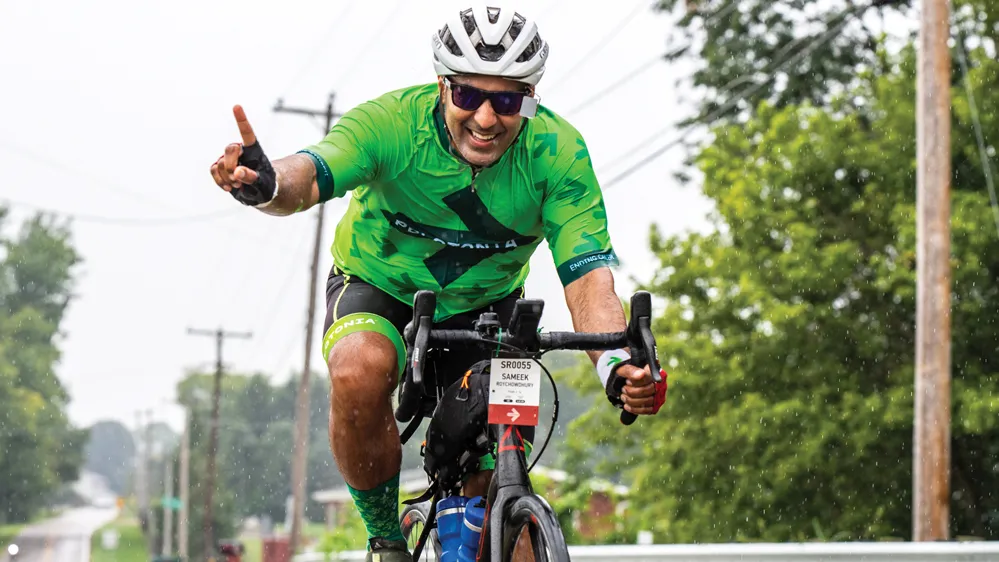

The doctor rides in every Pelotonia, which honored him in 2025. It’s been integral to his work, including funding his lab when he was recruited to build Ohio State’s precision cancer medicine program. (Photos from Pelotonia)
But Pelotonia didn’t just leave him exhausted; it also inspired him. “What brought me back the next year was the passion and the grassroots feel of Pelotonia,” he says.
Since then, he’s become a devoted rider, captain of his own Pelotonia team (Team Buckeye-Sameek’s Geeks) and the recipient of multiple Pelotonia Idea Grants for research. Last year, the organization named Roychowdhury the Pelotonia-Funded Researcher of the Year. When he was presented with that award, he coined the phrase that became the organization’s theme for this year’s event: No limits.
“He talked about his new telemedicine clinical trial [which was partially funded by Pelotonia] and said Pelotonia’s impact has no limits,” says Joe Apgar, CEO of Pelotonia. “When Sameek walked off the stage, he winked at me and told me, ‘No limits should be your campaign motto.’ We loved it.”
Pelotonia leaders often ask Roychowdhury to speak at events because of his passion and his ability to explain complicated cancer science in everyday language.
“He’s really warm and kind and such a gentle, brilliant guy,” Apgar says. “By coincidence, a few of my friends have been his patients, and they love him. One of my friends says he’s on his Mount Rushmore of all-time favorite people. Someone else I knew passed away, and Sameek was written about in his obituary. I’ve never heard of that before, but it shows you how important Sameek was to him and his family.”

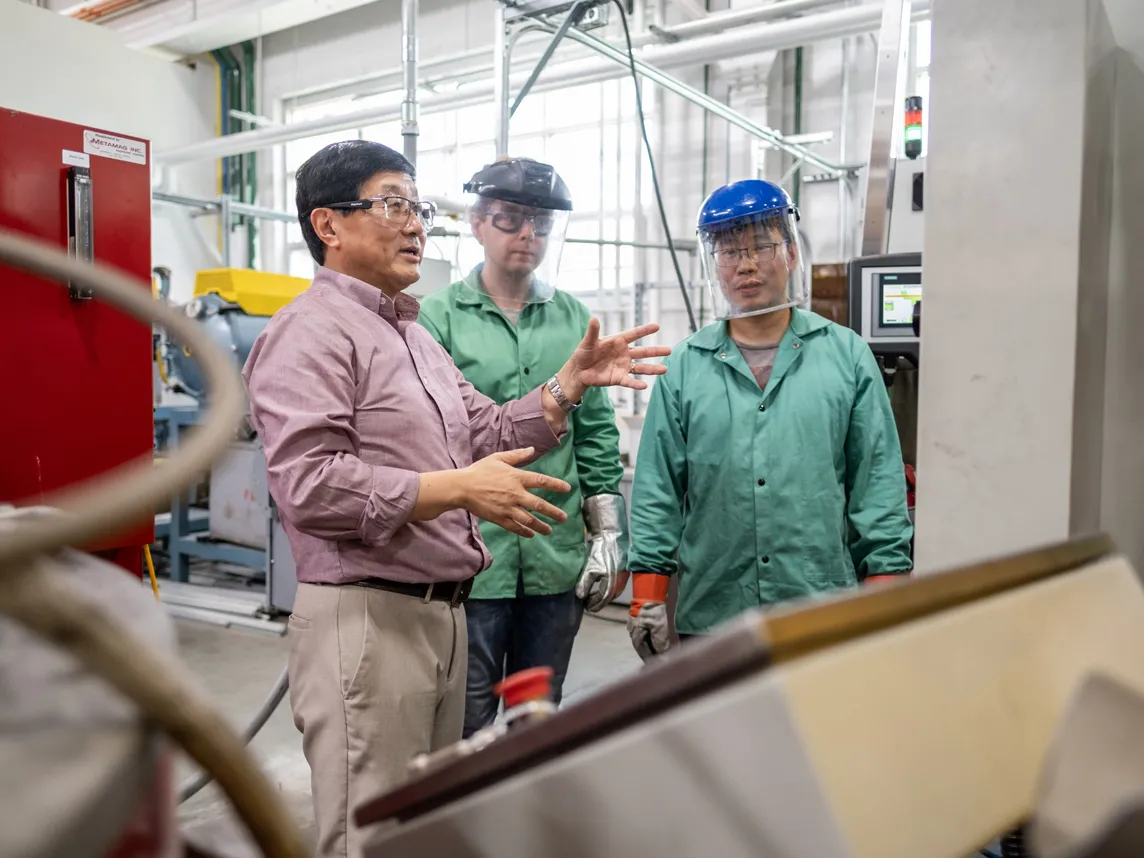
Roychowdhury and Reeser discuss blood samples mailed from cancer trial patients across the country. Their lab developed a better method to detect the mutation causing the patients’ cancers and a blood test to judge treatment effectiveness. (Photo by Corey Wilson)
Built to overcome
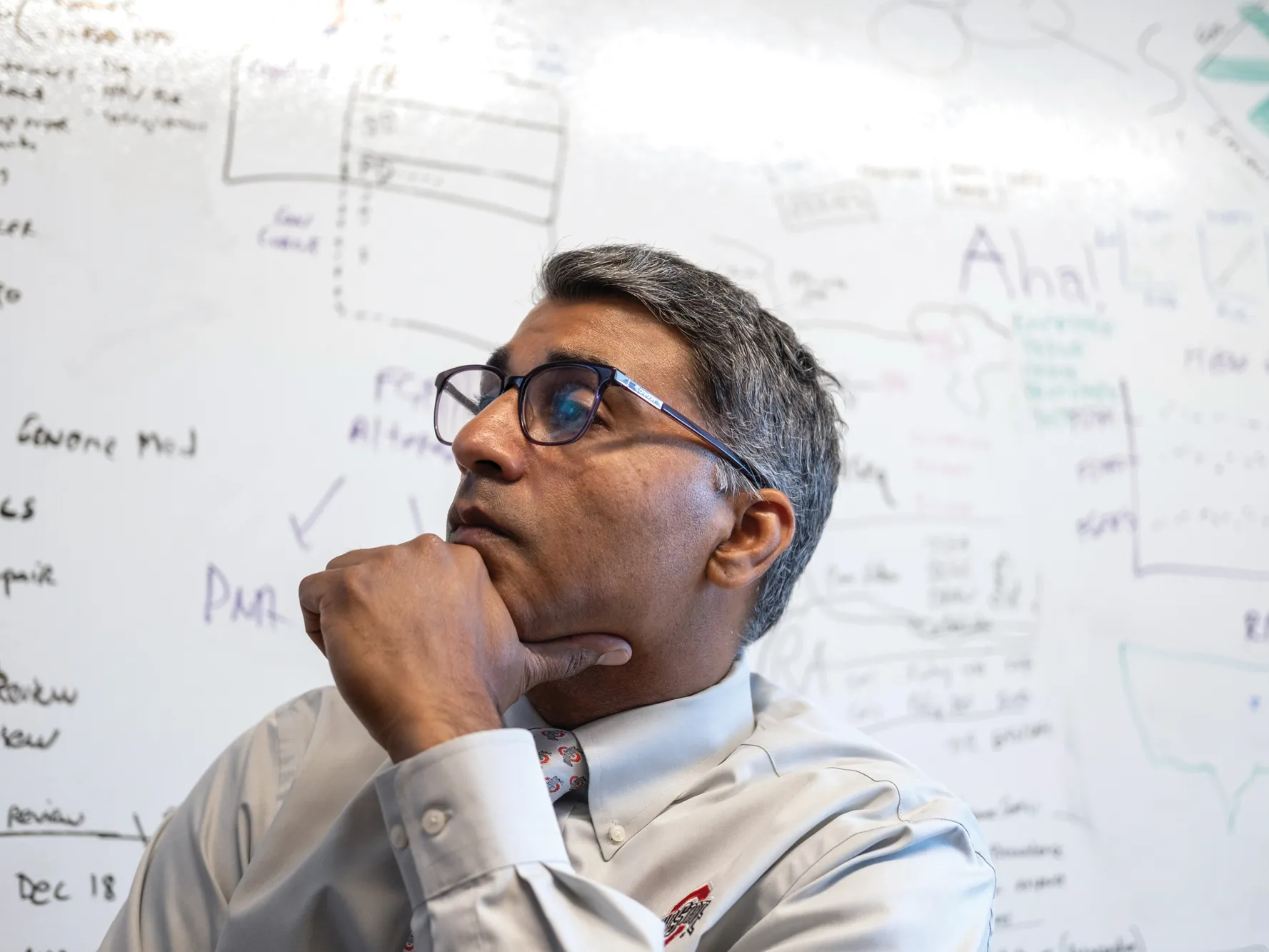
Julie Reeser ’13 PhD was one of Roychowdhury’s first recruits for his lab at Ohio State. “I know that sounds like a cliché, but he’s a nice, kind person,” says Reeser, who met Roychowdhury while completing her doctorate in genetics. “And he’s open to new ideas and encourages us, especially the young students, that it’s OK to share your ideas. Don’t be afraid to speak up. There’s no ego here; it’s all about teamwork and collaboration.”
Roychowdhury has ingrained in his lab a culture of creative problem solving. “There are always people telling you no, it can’t be done,” Reeser says. “But if Sameek believes something needs to be done, if it will help patients, he’ll find ways around the roadblocks.”
One of the lab’s first projects was a “basket” clinical trial, a new concept in 2012. Typically, a clinical trial treats a specific form of cancer, such as lung, breast or liver cancer. In their basket trial, Roychowdhury and his lab gathered patients with different types of cancer, all driven by the FGFR mutation.
“Patients with the FGFR mutation live eight months on average,” he says. “Our first patient did well, and we enrolled three others, and they lived two-and-a-half to five years. We thought this could provide us and other physicians with an opportunity to help other people.”
Another innovation was an organ donation study for deceased patients. “What we learned from this was that cancer cells become resistant to treatment in many, many ways,” Roychowdhury says, adding this knowledge will help improve treatment. His lab has also developed a better method to detect the FGFR mutation and a blood test to determine the effectiveness of the treatment.
Creating a nationwide remote trial for patients with pancreatic cancer and FGFR mutations was a goal lined with endless financial and logistical roadblocks. It seemed beyond reach.
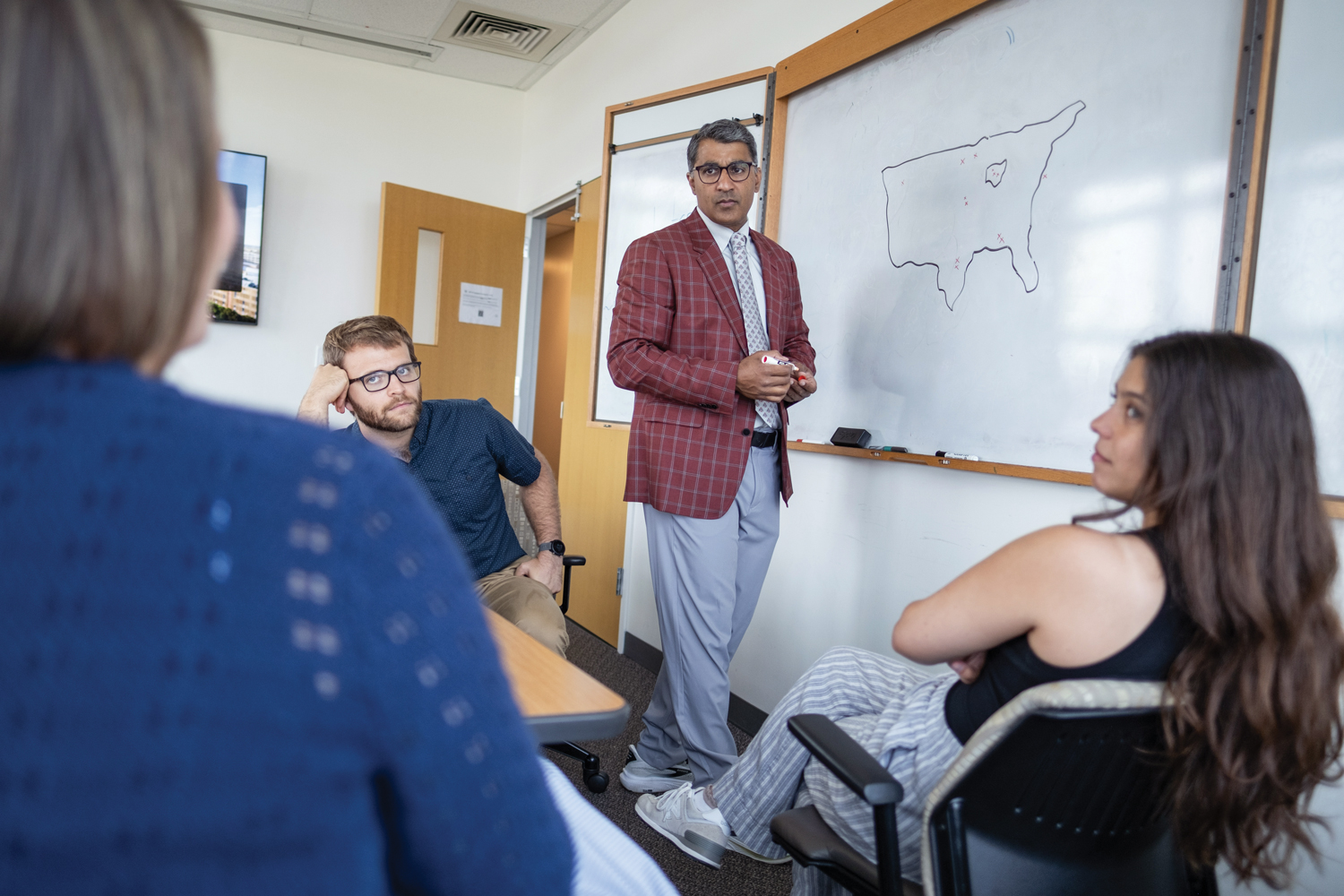
“It’s such a rare type of cancer, and you’d need to open the trial at 50 or more cancer centers to accrue enough participants,” he says. “Patients would still have to travel, and it would cost more than $20 million. For the drug companies, that’s not a good investment because it’s such a rare cancer. A traditional clinical trial wouldn’t work.”
And then the COVID-19 pandemic arrived and “everything was shut down,” Roychowdhury says. In March 2020, a patient in Fairfield, Ohio, was referred to him with uterine cancer fueled by FGFR. She had run out of treatment options—and hope. “She couldn’t come to the office, we couldn’t see patients. We applied for permission to proceed and spoke with her via Zoom and shipped the medicine to her.”
The drug was an inhibitor of FGFR, a precision cancer drug that blocks the growth and spread of the mutation. The Food and Drug Administration had already approved it for treating bile duct cancer.
“She began treatment, and the tumor shrank,” Roychowdhury says. “We eventually saw her in person a few months later, and we hugged and we were all so grateful and we thought: Can we do a nationwide remote clinical trial for patients with FGFR mutations?”
The answer was eventually yes, but it took a few years, partnerships with pharmaceutical support from Gateway for Cancer Research and Pelotonia, and overcoming a litany of bureaucratic hurdles.
The trial opened in May 2025. Eight patients have been enrolled as of July: two each from Ohio and Texas, one each from Minnesota, Virginia, Idaho and Wisconsin. About a dozen more patients from around the country are on a waiting list. “They’re not waiting on us,” Roychowdhury says. “They’re doing well on their current treatment, but if and when that should change, we’re here for them.”

“We’re working on a total of seven nationwide remote precision cancer clinical trials right now,” Roychowdhury says. Experts think the approach will be game-changing for patients with rare cancer, such as Stefanie Balm, shown here. (Photo by Brian Plonka)
The difference a trial can make
Before she enrolled in Roychowdhury’s telemedicine clinical trial, Balm, the Idaho patient, went through the two widely available forms of chemotherapy for pancreatic cancer. Eventually, she experienced disease progression, meaning that the cancer was spreading despite the treatment.
Ryan Carr, assistant professor of oncology at the Mayo Clinic in Minnesota, was part of Balm’s medical team. He found Roychowdhury’s telemedicine trial on ClinicalTrials.gov and contacted him. Balm was watching TV and folding laundry when she noticed an incoming call with a 614 area code.
“I answered the phone, and the kindest man introduced himself and said he had his team on with him. He said they were excited to have me in their trial; they thought it could help. This was the first time I actually felt some hope.”
Balm began her new treatment in February. Her pancreatic cancer had spread, and a tumor in her liver was large and painful. “And literally, within three days after my pills arrived in the mail, the pain in my liver was gone,” Balm says. “I thought it was a fluke. There’s no way it could work that quickly.”
In the subsequent weeks, Balm continued feeling better and a series of scans have confirmed her tumors are shrinking. “I go in every week to my local oncologist for lab work,” she explains, and the results are sent to Roychowdhury. She praises the Ohio State doctor and his team “not only for this clinical trial but for being so invested in my success and truly celebrating the victories with me.”
Roychowdhury believes remote trials like this will become a staple of cancer research and treatment and result in better outcomes for patients, especially those with rare cancers. “If you put all of the rare cancers together, it’s 40 percent of all cancers,” he says. “We struggle to develop new therapies for these rare cancers, and all these people will be left behind unless we have new approaches like this.”
The Mayo Clinic’s Carr predicts telemedicine clinical trials “are going to be bigger than I think most people in oncology have appreciated. … My hope is eventually we will be questioning whether physical sites for clinical trials will be needed.
“For diseases like pancreatic cancer, where many patients are too sick to travel and survival is short, that shift cannot come soon enough.”
Roychowdhury hopes to open additional trials for liver cancer, pancreatic cancer and soft tissue sarcomas.
“We’re working on a total of seven nationwide remote precision cancer clinical trials right now,” he says. Those would also target the FGFR mutation, as well as cancer-causing mutations in two other genes (KRAS and CDK) that regulate cell growth.
These telemedicine trials aren’t easy, Roychowdhury says. They force clinicians and scientists to learn new skills they may not have picked up in med school, such as how to connect with patients who aren’t in the same room with them. But the effort is worth it. Through this new approach, Roychowdhury says, oncologists let patients know “we’re going to do everything we can to help them and give them a sense of hope.”