Guardian of polar history retires after 30 years
Laura Kissel ’83 shaped Ohio State’s Byrd Center archives, ending her career with a Thompson Library exhibition.
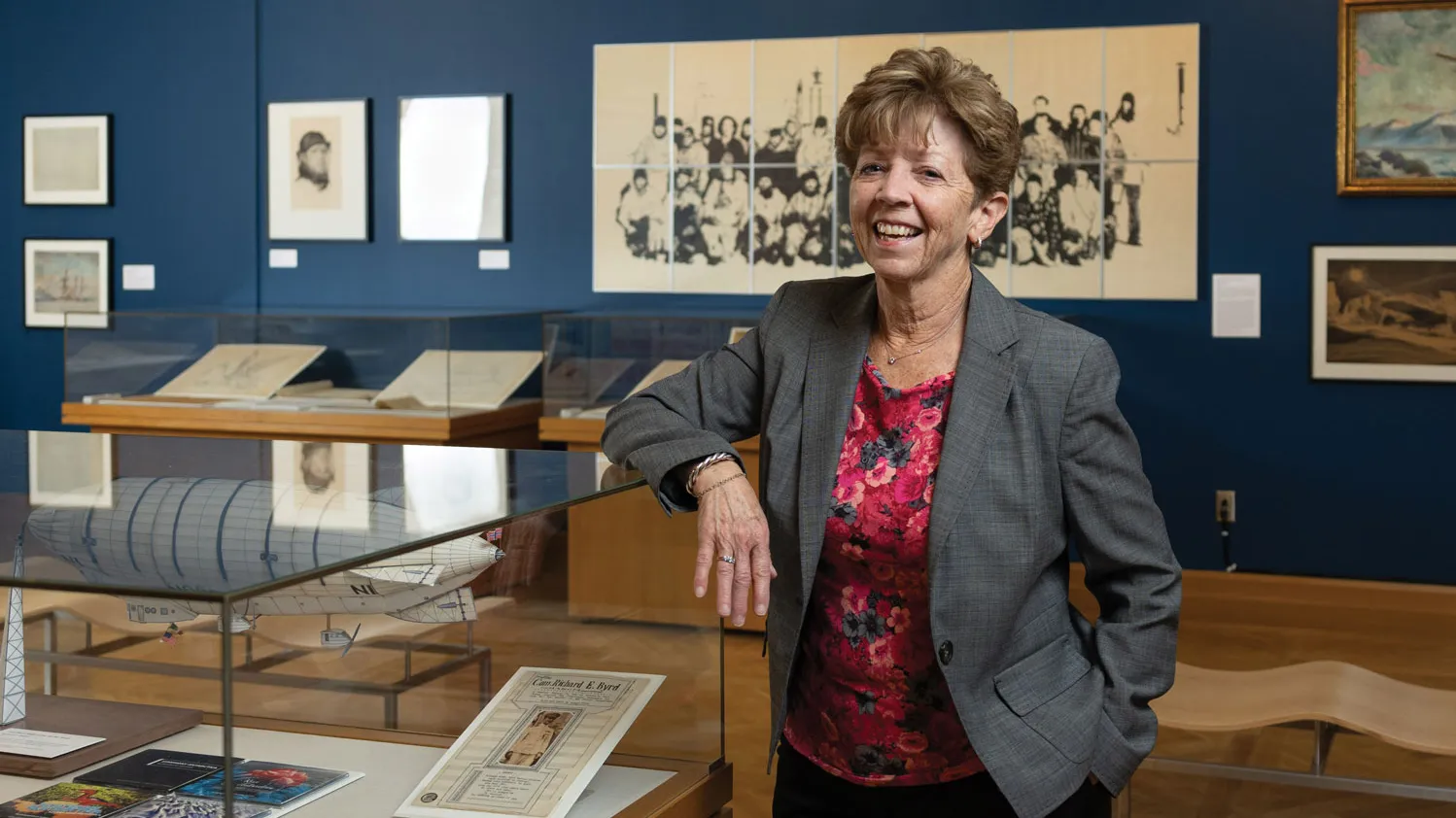
Laura Kissel (shown in the “Polar Expressions” exhibit) realized she enjoyed library work while working in a student job as an Ohio State undergrad. (Photo by Jodi Miller)
When Laura Kissel ’83 took a temp job in University Archives in 1996, cataloging the work of a polar explorer, she hoped it would lead to a permanent position. She never imagined that three decades later, she’d still be there and credited with transforming the Polar Archives into an internationally known resource.
In August, Kissel will retire as the polar curator at the Byrd Polar and Climate Research Center Archival Program (commonly known as the Polar Archives), one of the world’s most extensive collections of materials documenting polar exploration and science. Over time, Kissel has guided hundreds of researchers through the history of explorations in the Arctic and Antarctica, delivered presentations around the globe and served as a leader in the Polar Libraries Colloquy, an international network of librarians that will gather at Ohio State in June.
On any given day, Kissel can be found deep in the archives in a climate-controlled building in Columbus. Sometimes, she’ll jump into a forklift to reach the 30-foot-high stacks, which hold thousands of items from the Arctic and Antarctica—papers, artifacts, photographs, maps, weather data and even the clothing of polar explorers, such as a caribou fur coat worn by Adm. Richard E. Byrd, who led five expeditions to Antarctica.
Locked up in a safe is one of Kissel’s favorite items, a letter from aviator Amelia Earhart to Byrd.
The roots of the Polar Archives date to 1985, when Byrd’s family sold his collection to Ohio State’s Institute of Polar Studies, now known as the Byrd Polar and Climate Research Center. The center collaborated with University Libraries to create the Polar Archives in 1990.
“When I arrived in 1996, the Polar Archives had no dedicated staff,” Kissel says. “But once we began scanning our materials and putting information online, people all over the world began realizing that Ohio State had important polar history collections.”
As research requests surged, Ohio State hired Kissel as its first—and only—polar curator, assisting scholars, managing the growing polar collections (there are hundreds now) and working with the Byrd Center to preserve its scientific legacy.
“Laura is the link between ongoing science that’s happening in the Byrd Polar and Climate Research Center and the history of polar exploration,” says Tamar Chute, university archivist and Kissel’s supervisor.
Chute points to Kissel’s work with the papers of John Mercer, a Byrd Center scientist.
“Mercer was one of the first people to talk about climate change. Today scientists are revisiting his work and repeating his experiments. Laura helped make that possible by preserving and organizing his collection.”
Kissel’s latest project reflects another side of the polar story. “Polar Expressions: Finding Beauty in the Coldest Regions on Earth,” an exhibition on view at Thompson Library until Aug. 2, features art inspired by polar expeditions. Items on display include 60 luminous pastel paintings by an artist who accompanied Byrd to Antarctica, intricate stone and ivory carvings by Inuit artists, and striking photographs captured by early explorers.
Soon, Kissel will trade Ohio’s winters for a warmer life in Tennessee, where she and her husband plan to live near family. “I don’t like cold,” she admits. “It’s ironic given my job.”
That said, she has traveled twice to the Arctic Circle, visiting Alaska and Finland on work trips. For Kissel, that’s more than enough adventure in the cold.


See the exhibit
“Polar Expressions: Finding Beauty in the Coldest Regions on Earth” is on display at the Thompson Library gallery through Aug. 2.