Robots get smarter with a Buckeye’s big idea
With 200 employees and a mission to fill a big need, Andy Lonsberry ’13 and Path Robotics expect a promising future.
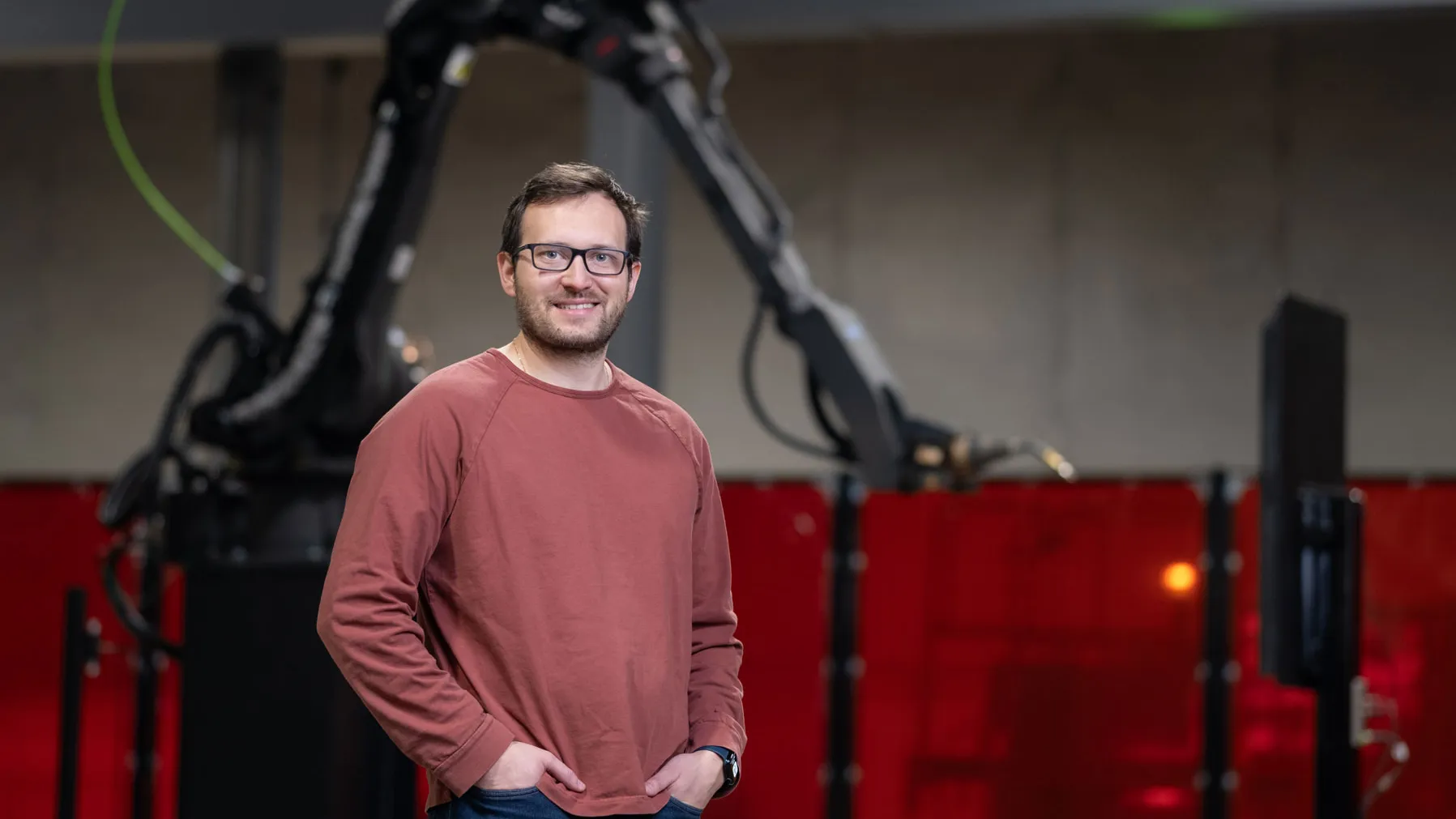
Andy Lonsberry and his brother started their tech company, which is now headquartered in Columbus. It sells to manufacturers across the continent. (Photo by Corey Wilson)
Andy Lonsberry ’13 delivers what the Wizard could not offer the Scarecrow: He gives each of his robotic welders a brain.
And Lonsberry—or rather his company, Path Robotics—also gives the machines eyes, ears and other sensory devices that provide the ability to do skilled welding tasks and learn from them.
With the help of AI, the robots work without the need for human welders or handlers to scan, position and weld parts. Amid a shortage of skilled welders, Path’s army of robots builds automobiles, ships, tanks and trucks, utility poles, data center infrastructure and heavy machinery across North America.
Lonsberry says Path is on a trajectory to triple its business year over year and has plans to expand to Europe and Asia in 2027. About 200 employees now fill the company’s 200,000-square-foot manufacturing facility in West Columbus. “We’re hiring 40 new people this quarter alone,” he says. An infusion of $100 million in venture capital in 2024 made that possible.
The company is about 10 years old, but Lonsberry has been focused on manufacturing for most of his life.
He and his older brother Alex, who started Path together, grew up in suburban Cleveland, where their father was a mechanical engineer. For about five years, he ran a family factory making off-road vehicles.
“When I was between the ages of 8 and 12, Alex and I showed up at the shop every weekend and worked on these systems. Manufacturing was ingrained in us from an early age,” Lonsberry says. “We liked working with our hands.”
While he was an undergraduate mechanical engineering student at Ohio State, the manufacturing sector was moving in new and exciting directions, led in part by MIT spinoff Boston Dynamics and its robot dog, Spot. “This was the first time we saw mechanical systems being controlled intelligently, and it was surreal,” he says.
Both brothers pivoted to incorporate computer science into their engineering education, with Andy learning programming languages at Ohio State. He had a goal of “not just building the mechanical systems but controlling the mechanical systems.”
Eventually, both brothers finished doctoral degrees at Case Western Reserve and launched Path Robotics from a basement shop in Cleveland. They moved to Columbus in 2019, partly to take advantage of Ohio State’s pool of graduates.
Robotic welding arms have been ubiquitous in factories for decades, Lonsberry says. But “with traditional robots, a human had to program that robot for every individual task, every individual part, every millimeter of motion. What that means is they are not able to handle any change to their environment, never able to learn.”
Using patented AI technology, Path’s robots can adapt to changing situations, make precise welds even with imperfect parts, and learn from every weld. According to the company, Path’s robots reduced welding time by 91 percent for TYCROP, a Canadian manufacturer of mobile power generation equipment that was facing a chronic welder shortage.
That shortage is what led the company to focus first on welding robots. In the future, however, Lonsberry envisions Path developing AI-powered robots that will assemble, paint, grind and package products as well.
Lonsberry knows there’s some public anxiety about artificial intelligence, but his fascination with intelligent machines was cemented during an internship in his Ohio State days. Working on a human exoskeleton at the Institute for Human and Machine Cognition in Florida, Lonsberry was on hand when a military veteran who had been paraplegic for 20 years took his first steps in the robotic support system.
“His family was there, and everybody was crying. He said it was one of the most humanizing events of his life. And that’s what seeded my interest in robotics. We can build technologies that really help humans in so many ways, and everywhere.”