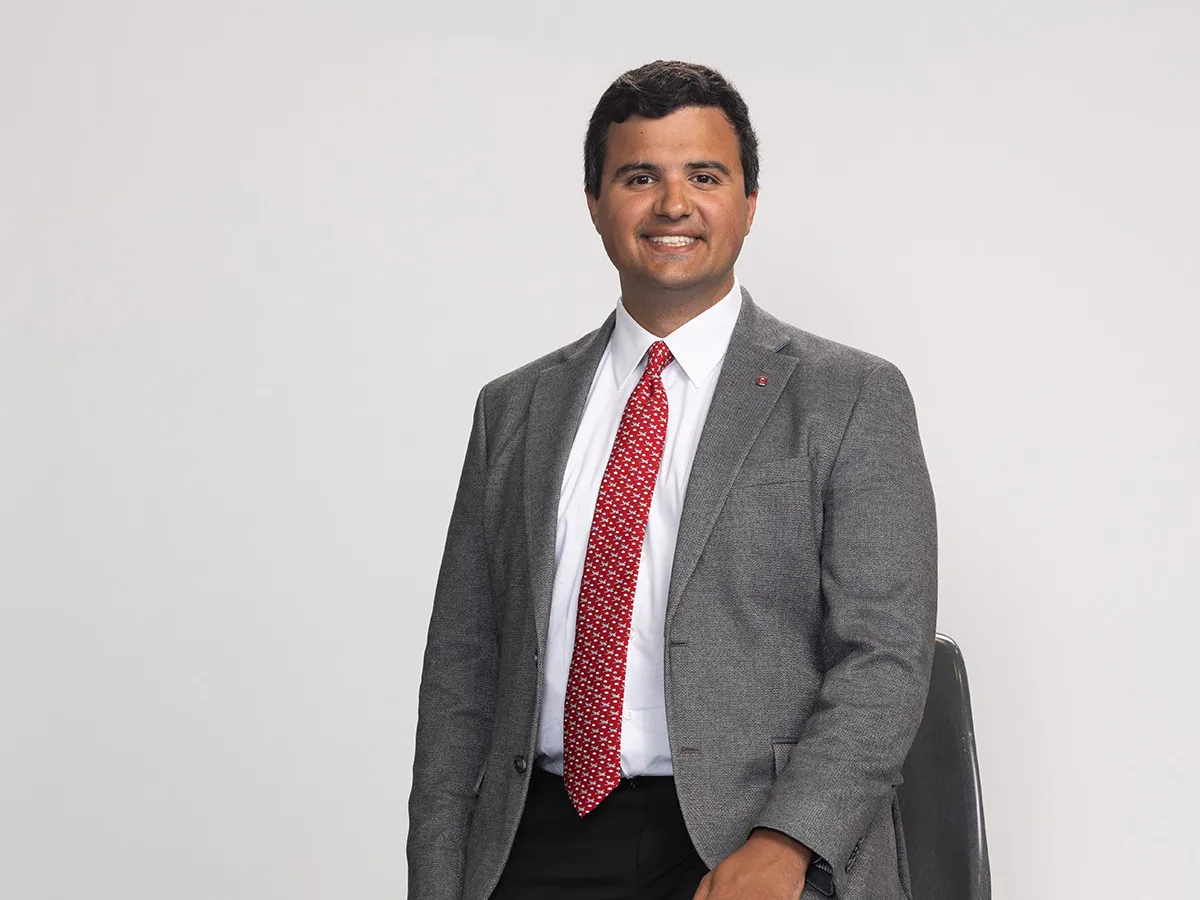
Winning with people: JT Terranova’s Buckeye blueprint
From Ohio to Silicon Valley and back to campus, this 1975 graduate is helping Ohio State invest in relationships and innovation.

James “Jim” Terranova ’75 never played football for Woody Hayes, but he’s spent five decades proving the legendary coach’s most famous principle: You win with people. From his work-study days in the Columbus law firm of former U.S. Sen. and Ohio Gov. John W. Bricker ’16, ’20 JD, ’39 HON, to 27 years managing investments in Silicon Valley’s most innovative startups, Terranova built his career on the relationships he’s cultivated and the people he’s championed. Now, he’s bringing that philosophy—and his venture capital expertise—back home to campus as advisory board chair and president of the Ohio State Early Investor Network (OSEIN), a membership-funded network developed by the alumni association and the Enterprise for Research, Innovation and Knowledge, and a member of the alumni association’s board of directors.
-
Tell us your Ohio State story. What brought you to Columbus?
The people brought me to Ohio State. I grew up in Niles, Ohio, a small suburb of Youngstown, though I had a lot of family in New York. Unlike many of my friends at the time who were intimidated by the sheer scale of the university, I was actually drawn to Ohio State because of its size. I wanted exposure to as many high-quality courses and people as possible, so I enrolled and began taking as many classes as I could manage. At that time, Ohio State had a flat-rate tuition model—I wound up graduating with around 220 credit hours, though I needed only 180 for my degree. There were so many interesting people and classes available to me that I just couldn’t help soaking them all in.
-
Your career has taken several interesting turns. Tell us about that journey.
During my last two years at Ohio State, I had a work-study role in Sen. Bricker’s law office. I developed an interest in corporate law, and after graduation, I moved to Los Angeles, beginning a career as a stockbroker by day and attending law school at night. Eventually, I realized that corporate law wasn’t a pathway I could take as a part-time, night school student, so I decided to pursue an investment career instead. I worked with a Wall Street firm for 20 years before transitioning to the private side of investing in the mid-1990s with the law firm of Wilson Sonsini in Palo Alto. I managed the in-house investment funds for the better part of 27 years. I’ve now been teaching venture capital courses with Stanford University’s continuing studies program for several years.
-
And now how are you leveraging your expertise?
Paying forward, as you well know, is the Buckeye way. I take that charge very seriously. I began serving on the Fisher College of Business’ alumni board around 20 years ago, and I worked closely with Dr. Michael Camp, who created the Technology Entrepreneurship and Commercialization Institute at Fisher. I’ve also had the pleasure of hosting Fisher MBA students in Silicon Valley every year for 21 years, exposing them to the networks and environments that can support their career transitions once they’ve finished their degrees.
Seven years ago, I joined the Ohio State Innovation Foundation Board, and three years ago, I was tapped to lead OSEIN. I have been so excited about entrepreneurial energy at Ohio State, and I’ve long thought that Central Ohio has the conditions to replicate what’s been happening in Silicon Valley: a large research institution, a significant industry presence and a cadre of bright, motivated people.
But we’re missing a few things: the legal firepower and accounting structure needed for that kind of growth, as well as the capital to get these projects started. That’s where OSEIN comes in. We have two tracks of startups that we support in OSEIN; one is for student-led projects, and one is for university researchers.
-
How can Ohio State invest in Ohio’s future?
We need to do something different. For years, what we did in Ohio was farm, make steel and make cars. We’re still farmers. We don’t make very much steel, and we don’t manufacture cars anymore. So what do we do now? Well, one option is to invest in the ecosystem that OSEIN and our partners are building—the financiers, the mentors, the teachers of entrepreneurship. It’s almost existential for Ohio to survive. After meeting with President Walter “Ted” Carter Jr. and hearing the university’s commitment to taking the innovation initiative into the stratosphere, I’m feeling optimistic. Whatever Ohio State can do to preserve talent and opportunities for the people of Ohio—I’m all for it, and I’m happy to be part of it.